ads

Slider[Style1]

Style2

Style3[OneLeft]

Style3[OneRight]

Style4

Style5

Slot Coverage Variations

400th post, y'all


After covering front matching previously, we can now explore options available to handle slot sets that are separated from the box. Typically, this is best understood from a 2-back look with a single receiver on the other side of the slot (allowing a variety of bracket looks and the linebackers matching back flow). The passing strength is immediately identified (slot) and the safety, corner, and overhang player can communicate how they would handle the 2-man routes out of this. These methods can also be applied independently to each side (split-field) when facing 1-back, as well.
 
With two receivers split from the formation (slot) you end up with a 3-on-2 advantage for the defense. As we covered before, there is a variety of ways to handle this. In attempt to tackle two things at once, we’ll cover these concepts using Saban-speak (out of Nick Saban’s playbooks). It should be noted that Saban’s “system” is extremely concise, flexible, and modular (in its application). What comes with those benefits is a dictionary full of terminology to communicate every conceivable action and response on the field. We’ll use his method as a way to keep a central thematic framework, but these concepts are relative to what everyone else does (so don’t get hung up on the verbiage).
FIST

The first is basic Cover 3 Sky (“Fist”) with what amounts to be the old “country cover 3”. Fist brings the overhang player down outside of #2 receiver serving as primary force. This defender will drop into the seam and not carry any route by #2 deeper than 12 yards and jump the first receiver to the flat. The corner would play all of #1 receiver vertical (or #2) out and up. The free safety would play middle of the field to the #2 receiver. Because these two receivers are handled by these three players, additional receivers (releasing back) would be immediately jumped by the next linebacker inside (Will) unless #1 or #2 released inside.
 
Examples of matching in Fist
     
Exceptions
  • Vs 1 back – the FS will check to Rip/Liz rules (match left/right away side) and man #1 and #2.
  • Vs Wide slot split (horizontal stretch) – with a great deal of space underneath to cover, a “TOKYO” (smash rule) call can be made to have the corner take all short routes and have the overhang defender carry a vertical stem.
 
Sky (Fist) remains an all-purpose coverage solution to slot, but can face limitations with quick 2-man games against the overhang player.


COVER R - ROBBER

We’ve covered robber coverage before and this version would be just like Virginia Tech plays it. This is best against a tight #2 with the FS dropping into the seam and the overhang player immediately expanding to the curl. This isn’t much different than TCU’s ‘2 Read’ (covered before). The FS acts as the robber, reading #2-to-#1, playing the front hook with a #2-to-QB-to-Alley fit progression.
 
The corner immediately drops to the deep third with the overhang defender jumping first receiver to the flat. With the corner committing to the deep half, any vertical route by #2 will be bracketed inside-out by the FS and corner.
examples of matching in robber
    
Robber coverage remains arguably one of the best run down solutions, especially to the field.  1-back looks can be handled by robber, but do not provide the leverage security that 2-back does.


COVER 2 - CORA

This is traditional cover 2 cloud with the FS over the top in deep half coverage and defenders in the curl and flat. The overhang player will align inside #2 and the corner outside of #1.  With two outside underneath zone defenders on top of two split receivers, you have the ability to aggressively attack the quick game.  With any slot coverage, you are only as good as your answer to the smash route.  With true ‘Cora’, the force corner will sink in the flat (playing “TOKYO”) and the overhang will carry #2 vertical.

 
examples of matching in Cover 2  
      
 
Cover 2 is great against quick game and perimeter run game.  How a defense matches vertical routes in Cover 2 will typically be its weak spot.
 
 
One adjustment to this Cover 2 look is known as “Leach”. It is exactly the same with the exception of the overhang defender is man-to-man #2 (slot/curl). This would afford the (usually exceptional) slot receiver to be double-covered underneath or deep with the surrounding zone defenders.
 

COVER 4 - THUMBS

Thumbs is a 3-on-2 quarters principle that can morph itself into swipe bracket when only one receiver is vertical. The FS will double #1 or #2 from inside out with the corner playing deep third outside.  The overhang player is the sole underneath defender and will take first shallow out / in receiver between #1 & #2.
examples of matching in thumbs 


Quarters is great against vertical game and play-action, but the lack of underneath support can cause perimeter leverage issues the offense can exploit.
   

COVER 5 – COUGAR / IOWA
Adding this as a final thought, Cover 5 is the man-under with deep half help. The FS will rob everything inside with the ability to double either receiver deep.  I didn’t provide any illustrations as it is pretty self-explanatory and is the ideal passing coverage.  The FS will rob everything from the inside.  Because the corner (your best cover guy) will be man-to-man on #1 outside wide “on an island”, you will typically have a 2-on-1 cone/bracket on #2 between the deep safety and the overhang player.

Get Back To Fundamentals: Coverages

Here for your reference archives – basic examples of the types of coverages everyone runs; 1-high to 2-high.  For more information, click on the hyperlinks/tags of each coverage type for previous entries for more in-depth explanations of what you’re seeing.

COVER 1


COVER 2


COVER 3

Backer force

Safety support

Corner support


COVER 4


COVER 5 (2 Man Under)


Unrelated to everything.... Just passing along an interesting development in artistry.....something interesting is afoot with one of our time's most creative storytelling voice, David Simon (and company).  Simon, of "The Wire" fame (and brilliant treatment of "The Corner" and "Generation Kill"), is deep in his current passion; the unique Americana invention of New Orleans music told through its principle actors (the musicians). The visual-novel of  "Treme" nearing the end of its second season has become an acquired taste for many.  Those missing out on the brilliance in its subtleties (it isn't meant to be swallowed whole, but savored by digesting each scene) of scenes and dialogue are losing sight of what the series (and Simon's craft) is about. I felt it was worth noting as the appreciation of performance art (and original storytelling) is becoming a dying craft.  Perhaps best summarized here by actor Clarke Peters.
My point in offering these thoughts is to pass along an observation of the use of technology as the social apparatus of our time.  The series (like any other event) is being chronicled online in various blogs.  One of which, Back of Town ,  has become a way of appreciating the episodes with many people responsible for telling this story.  With regular, affable interaction with (the real) Davis Rogan, Tom Piazza, David Simon, and Eric Overmyer and from the perspective of a 1-to-1 relationship (and not that of a lecturer or host), giving participants the organic feeling of being involved in the actual process.  This type of discourse wouldn't have been possible even five years ago - its exciting to watch this process develop, especially in the environment that this series has found itself in; a humble and artistic community of writers with a production geared for the exact opposite [commercial] appeal of its on-air counterparts.  I'm not sure what will come of it, nor am I star-struck that the production team would interact with consumers, but how it shapes the course of artist-audience relationship is something to watch.

Rip / Liz (Revisited)

As touched on earlier, this coverage adaptation to 3 deep zone fills the holes of 8-man fronts vs 1-back.  I’ve consolidated the lecture and video for (hopefully) a better illustration of the concept.

TCU "2 Read": Adaptation To The Spread (3x1)

The robber rules of “2 Read” are rather simple and the biggest part understanding TCU defensive scheme is just coming to grips and accepting the split-formation concept they utilize.
Using the same “2 Read” technique rules we already covered, we plainly go over adding another receiver (3) to the read side.
To the trips side, the free safety and corner will be playing straight drop back and essentially end up in a split field ¼ match. The primary adjustment becomes the strong safety. He will be outside of the #2 receiver. He is going to play standard “blue” coverage rules, staying on #2 to prevent three verticals. He will still “Swing deep to 3” but he is not looking to jump the flats as he was versus 2 receivers.

In the worst case scenario, “all verticals”, the corner will zone turn to bail and split the difference of #1 and #2 receivers. The free safety will backpedal weave leverage of the vertical #3 receiver. This is the ‘jailbreak’ option versus this coverage, if three verticals aren’t run to the trips side, the pattern distribution can easily be accounted for in the rules.

So if #2 receiver or #3 receiver is not vertical, now we're back to the manageable 2 receiver threat. If #3 runs a shallow out (for example) the free safety is no longer threatened in the middle of the field, so he will settle and look to rob any route by #2. The corner will have the post by #1 all day, so the free safety is free to look of #1.
Versus a standard trips flood (#3 shallow out, #2 sail, #1 is in), the corner would stick with his communication rules, call the “IN” by #1 and gain depth over the receivers. With the “IN” call, the strong safety will hang (on the curl) and break late on the out of #2.

This was just an overview of the split-formation coverage of TCU out of their robber package. Feel free to check out the RUNCODHIT articles on their usual 2x2 coverage (Blue/ Cover 5) that we’ll see a lot of in their push for National prominence this season.

TCU "2 Read": Adaptation To The Spread (2x2)

While exploring the defensive adaptations to offensive trends towards "the spread" (Va Tech in the 90s / Saban Cover 3 adjustments ), and not intending to repeat any of the fantastic coverage of TCU defensive tenets done at Run COD Hit, it would behoove us to at least go over how TCU would confront 2x2 / 3x1 formations out of their base split-field coverage, '2 read'.

TCU's 42 defense is based out of Cover 2 "Read", which is really just a robber + quarters read out of a MOFC look. TCU will typically not play ‘2 Read’ against any 1-back look (preferring Blue or Cover 5), so what we are presenting is just a ‘worse-case’ scenario against this coverage.

Since they are splitting the formation in half, they are just reducing the concept down to the 1, 2, or 3 receiver matching. Just like the Rip/Liz adjustment covered before, when facing a balanced 2x2 formation, the secondary would have to declare which side they are going to play as the 'read side' (where the FS will be robbing). If '2 Read' is called, versus a 2x1 formation, the FS would naturally rob the receiving strength (2 receiver side). With 2x2, you would have to declare "reading left" to communicate the 'read side' and the 'away side', alerting the away safety on how he will handle #2. To the 'read side', this is how zone distribution would essentially play out in a nutshell.

"2 Read" is the base coverage TCU bases out of (it really is just robber). They may not even run this coverage much after installation, but it remains the elementary foundation for all subsequent variations regularly employed.

To get down to brass tacks, the rules are relatively simple and outlined below:

Since they are splitting the formation in half, they are just reducing the concept down to the 1, 2, or 3 receiver matching. Just like the Rip/Liz adjustment covered before, when facing a balanced 2x2 formation, the secondary would have to declare which side they are going to play as the 'read side' (where the FS will be robbing). If '2 Read' is called, versus a 2x1 formation, the FS would naturally rob the receiving strength (2 receiver side). With 2x2, you would have to declare "reading left" to communicate the 'read side' and the 'away side', alerting the away safety on how he will handle #2. To the 'read side', this is how zone distribution would essentially play out in a nutshell.

"2 Read" is the base coverage TCU bases out of (it really is just robber). They may not even run this coverage much after installation, but it remains the elementary foundation for all subsequent variations regularly employed.

To get down to brass tacks, the rules are relatively simple and outlined below:

Read Left

  • Read side Corner- 1x7 match deep vertical threat
  • Strong (read) Safety - 5x1 force on run / pass read: open to flat "swing deep to 3"
  • Free Safety- alley fit on run / pass use 'Robber rule' - vertical by #2 / no vertical by 2, rob curl-to-post of #1
  • Strong Backer -match #2 - #3
  • Weak Backer - match #2 weak vertical
  • Weak (away) Safety -run force / pass curl-flat "swing deep to 2"
  • Away side Corner-deep 1/2 (over post of #1)

Read Side Communication

Corner is 1x7 in press bail shuffle with a man-clue of the #1 receiver. Corners always 1x7 unless #1 receiver is outside of numbers (they never cross the numbers in robber). Corners always play inside leverage, always protecting the post (because you don’t know if you’re going to get help from the FS). The post-snap cushion is not enforced, and in fact, Patterson wants receivers to break the defender’s cushion so he’ll only have to play one side now. If there is only one receiver split, the corner will man-turn into the route. If there is more than one receiver split, he will zone-turn into the route. Because this is a robber concept, the corners are taught to make the post a priority and, if necessary, align as much as 4 yards inside the receiver to protect the middle of the defense. With these rules, Patterson essentially invites offenses to run the post-corner because he feels he can take everything else away and force this difficult throw. To get the most out of this coverage, a pattern-match communication system is utilized to hasten how the 3 key defenders respond. The corner will communicate pattern response to his area players (FS & read side safety). Of the read side calls he will make (and responses) are:

CHINA

If #1 is short/hitch the corner makes a “China” call. This flags man responsibility for the Strong (read) Safety. The read side safety will run under (to) #1 because the corner is sinking (on corner route) to match the first outside short threat (flat). A short #1 with a detached #2 receiver typically is going to give you a “smash” (or China) concept, with #2 continuing to press vertical. With #1 shallow, the corner will declare “China” and immediately look to match #2 over the top (and outside). The “China” call also help identifies that there is no post threat from #1 and that #2 is the only other possible threat vertical, so the Free Safety will look to aggressively jump the route of #2.

OUT

If #1 receiver breaks out (he’s no longer vertical) the corner will continue to sink and look to match #2. The ‘out’ call alerts the Strong (read) Safety to look to rob #1 underneath at 10 yards out. Since this overhang safety is always aggressively expanding to the flat, he won’t be giving up much separation on #1, so the throw (to #1) would have to be shallow and near the sideline for a completion.

IN

If the #1 receiver is not shallow (‘china’) but breaks inside at a depth greater than 8 yards (‘dig’ / ‘curl’) , the corner will communicate an “IN” call . This alerts the read safety that there is a threat coming inside over the top (of his drop). The safety should look to become an outside-in player (he’s going to the flat right now, because he’s got a curl player dropping - the FS).

Strong (Read) Safety

The (overhang) Safety aligns 5 yards deep on #2 (removed). Versus a standard tight end or pro look, he would align 3 yards deep and 7 yards widen (discouraging being reached on perimeter action). On EMOL high-hat pass read the target depth for his drop will be 8-10 yards. He is going to remain shallow on his drop with the intent to expand to the flat as quickly because the FS will be dropping inside of him in the curl (if that is what is threatened).

Don't get hung up on semantics - the 'read' safety "swing(ing) deep to 3" is essentially the standard 'curl-to-flat' responsibility, but an emphasis on staying shallow and man-conscious. This methodology helps the defender be less dogmatic and be an aggressive matcher in coverage ( if a man runs through his zone – he's got him vertical ). The rationale behind teaching it this way is to encourage the safety to open up and get to the flat (with no landmarks).

Free Safety

The alignment of the free safety will be 8-10 yards deep over the read side guard. This allows him to gain a clear read on an uncovered linemen and an quick response path to the inside vertical threat of #2.

Once the offense breaks the huddle, the free safety will identify the backs, determine the read side and communicate to the other defensive backs, “check 2 – read right” (coverage and what side is being matched). The response of the free safety is just like robber, with the #2 receiver as his pass key:

  • #2 goes vertical, he matches all of #2 inside leverage.
  • #2 does anything but vertical, he robs the curl/post of #1.

This vertical-clue will handle all routes deeper than 8 yards. If #2 is out (and under 8 yards), the free safety is communicating “WHEEL” to the corner (see the curl-flat combo illustrated above). This is essentially telling the corner, “you have an outside route by #2 - so you have curl-post help (from FS)”. This works even if #2 isn’t going to wheel that out route, but it lets the corner know he can now back off of #1 because of the help available.

When #2 is no longer vertical (out / out-up), the free safety then reads the hips of the #1 receiver. If #1 sinks his hips (for a break) the free safety will drive at the receiver’s break and step in front of him (interception point).

If the #1 receiver doesn’t sink his hips, the free safety immediately turns into the middle of the field (away from the receiver) to rob the post.

Inside linebackers
TCU's rules split-coverage rules mean they never have to displace the 6 in the box. The stacked (inside) backers would always match 2-to-3 regardless of formation with the other (away from final 3) being the rat in the hole. So if you’re a 4-2, its all relative if you play this with a 3-3; the numbers are the same. These players doesn't have to be anywhere fast, in fact, the slower they are at reacting the better, because they should be thinking draw or screen (off pass-action) initially.

For read side linebacker, once pass shows he is to middle drop vertical to find/match the final 3 receiver. This player is looking to defend his run gap first, then take away the hot (throw). By slow-playing pass action, he always tries to make #3 go over the top of him, and from there it just becomes a "man-to-man" zone as in basketball (boxing out #3 deep).

For the away side linebacker, it is essentially the same as the read side linebacker, with the exception of matching #2 (away) vertically. Typically, this player is the (wider) bubble backer and against any 1-back look, TCU will be slanting the defensive line. This linebacker must replace the former middle-of-the-field safety in the hole. Rather than a ‘robot’ reaction away from the ‘final 3’ player, he would gain depth vertically on #2. If #2 pressed vertically after 8 yards, the away side linebacker would have to carry him man-to-man regardless if he makes a break deep in his route. It isn’t pretty, but that is the answer for 1 back routes.

Weak (Away) Safety
On pass read, this player will play like a standard curl-to-flat player in cover 3. He has no immediate curl help and will work in tandem with the corner. He does not carry #2 deeper than 8 yards and does not reroute. He should never cross the hash when responding to an inside route, as the away side linebacker will be working to that area.

This is actually a great addition to standard robber coverage and the adjustment (with split-field) principle helps prepare your players for the ‘breakable’ scenarios. In the next (soon) installment, we will go over the very basic trips (3x1) adaptation using this same coverage.

Nick Saban: Cover 3 Adaptation (Mable/Skate) To 3x1

Continuing the review of handling one-back spread formations, the next logical step after you've accounted for 2x2, is how do you handle 3x1 (trips/trey)? All your adjustments to 2x2 can be pointless if you don't have a viable solution that can be 'broken' by a 3-receiver formation.
The Saban way of handling 3x1 out of Cover 3 is known as "mable", which is code for 'man'. This is actually a standard adjustment to trips if you're basing out of quarters. "Mable" (the same thing as "skate" in Cover 6), is manning the single-receiver backside, and pushing the zone coverage to the passing numbers. You're essentially playing zone front side and man backside.


The front side players will simply match the receiving threats as they normally would out of Cover 3. A lot can be assumed that the Cover 3 adjustments to spread are philosophical changes in how the secondary is played. Actually, that isn't the case - the 'secondary' teaching is quite subtle. The fulcrum of the Rip/Liz/Mable (3 deep zone) success is going to come with your inside linebackers. Those two players will control the guts of the coverage, and fully support everything that is being handled by the secondary.

As you can see by the diagram, nothing much changes with the secondary players. We will go over how the "alert" players (M&W) are to handle 3x1 formations:


btw - this becomes the "Zeke" adjustment to any trips look


This isn't a different coverage, just a built-in system for handling stressors of the base concept, and doesn't deviate much at all (from the call side) the standard pattern-match rules.

Let's go over the rules.....


In 3x1 (mable)
Will – backer to the single split side.
  • Back flow TO – match it (jump the flare)

  • Back flow AWAY – cut the 1st crosser

Mike – backer to 3 receivers (final 3 player) Related to #3 receiver after distribution
  • #3 is inside - ROBOT, depth and jump underneath inside breaking route

  • #3 is outside - push the strong hook

Sam – (to trips) Relate to #2 receiver after distribution.
  • #3 inside (M has him) depth and jump #2

  • #3 outside carry inside-underneath

Strong Safety – (to trips)Looking to jump the first underneath receiver. Relate to #1 receiver after distribution)
  • #2 outside – jump it

  • #2 inside (S has it) buzz underneath

Corner (to trips) simply plays old 2-to-1 read Cover 3 because he has to match the 1st vertical threat.


Again, as you see the reaction of the inside linebackers becomes the fundamental under current of Rip/Liz/Mable/Skate, allowing them to aggressively play run (flow) and put them in great leverage position based on this reaction. If those inside backers are trained appropriately, you will have an automatic response to handle most every route combination.

As a footnote, I'll just say that we've covered adaptations, the evolution, of standard zone coverage (by one who has been setting successful trends for a few decades). Saban, himself, doesn't just sit in one coverage throughout a game or rely on these rules / adjustments to beat-all. His defenses and how he uses/employs them is actually quite different. Using a 'pro approach', the defense is purely situational and will handle formations, D&D, areas of the field, differently and on a situation-by-situation basis.

Nick Saban: Cover 3 Adaptation (Rip/Liz) To The Spread

After providing an overview of playing Cover 3 with pattern-matching principles, we'll now take a look at the adaptations utilized to strengthen this basic concept.

A mantra comically repeated within the circles of "Air Raid" offenses is, "everything works against Cover 3", meaning whatever the concept, you can pass at will against most cover 3 defenses. With natural voids in the defense in the flats and in the seams, the four underneath defenders are typically the lynch pin of how successful a cover 3 defense will be.

The easiest threat to victimize cover 3 is the #2 receiver in the seam. The defense must be able to account for this threat or it will spend much of the game seeing the free safety 'wrong' on a 4 vertical threat.

and so the chess match, begins
To accommodate for this deficiency, Saban's defenses have evolved through the last decade with a "Rip/Liz" match based on where the safety drops into the box (Rita / Linda) against the 2 quick threat (2x2).

From Coach Saban, himself

When you’re playing a passing team you always have a better chance with split-safeties, but with all this zone read / zone option stuff we see…all the spread stuff, sometimes you’ve got to be able to play middle-of-the-field coverage to get an extra guy in the box.


We got to the point where, this is the reason that we do this, when everybody started going spread we couldn’t play 3 deep zone. This started with the Cleveland Browns, I was the defensive coordinator in the early 90s and Pittsburgh would run 'Seattle' on us , four streaks. Then they would run two streaks and two out routes, what I call ‘pole’ route from 2x2. So we got to where could NOT play 3-deep zone because we rerouted the seams and played zone, and what I call “Country Cover 3” (drop to your spot reroute the seams, break on the ball). Well , when Marino is throwing it, that old break on the ball shit don’t work.

So because we could not defend this, we could not play 3 deep, so when you can’t play zone, what do you do next? You play Man (cover 1), but if their mens are better than your mens, you can’t play cover 1 .


We got to where we couldn’t run cover 1 - So now we can’t play an 8 man front.
The 1994 Browns went 13-5 , we lost to Steelers 3 times, lost 5 games total (twice in the regular season, once in the playoffs). We gave up the 5th fewest points in the history of the NFL, and lost to Steelers because we could not play 8-man fronts to stop the run because they would wear us out throwing it

We came up with this concept; how we can play cover 1 and cover 3 at the same time, so we can do both these things and one thing would complement the other. We came up with the concept “rip/liz match”.


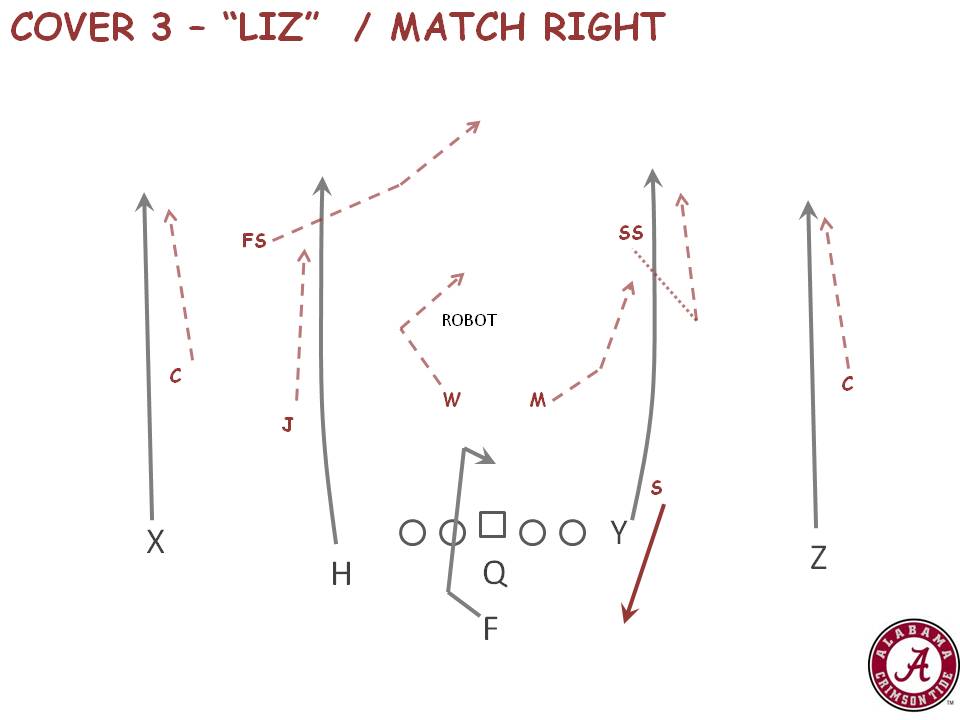
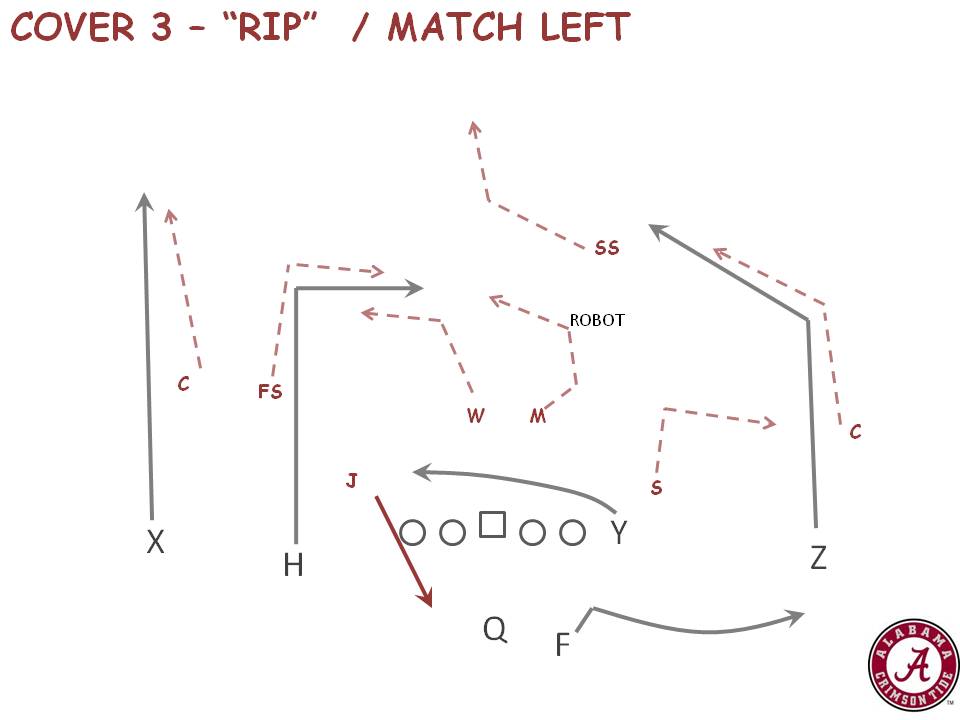
The "Rip" / "Liz" call will alert the OLB to the call side that he has a safety coming down who will be assuming the Curl/Flat responsibilities. With the Rip/Liz declaration, the backers away from the call will alert to "Match" ("Rip - Match Left") their quick away from the call, and how the corner to his side will match their receivers. It is all premised on controlling #2 deep in the seam, by catching and carrying #2 vertical or outside past 12-15 yards (this should start sounding familiar to BRONCO/SCIF technique). If there is no threat of 2 verticals to a side, it really becomes your standard fare Cover 3. If #2 crosses / goes inside, he communicates with an "Under" call (alerting the backers inside to cut the receiver) and turns his focus to rob #1 underneath (like standard Curl/Flat Cover 3, robbing inside and underneath #1).
It is essentially saying to the corners and C/F player, "versus two quicks, we're man-to-man all the way, unless our guys breaks inside". The communication is the vital part of the equation. Because the defense is presenting a 2-high shell, you could be playing a Cover 2, 4, 7, or 8 concept, but when you drop the safety down, you have to have a fast and efficient way to communicate which safety is dropping and how the backers away from the drop will respectively handle their threats.

Worst case scenario in Cover 3 is the 4-verticals concept (4 receiver on 3 deep defenders). Rip/Liz match specifically handles this. If you accommodate for 4 verts, you aren't left with many other issues that can hurt you because you will still have 6 in the box. Getting down to brass tacks, lets review how this concept fleshes itself out.

If #1 is vertical and #2 is vertical (VERTICALS)


#1 presses vertical, the corner takes all of #1 - #2 presses vertical, the C/F players takes all of #2
The inside linebackers will match #3 as he presents himself, looking to expand from the hook zone. By carrying the two inside verticals, remember you still have a middle of the field safety, so the backer/safety carrying #2 can maintain a low-shoulder, outside leverage on the receiver. This puts him in great position to discourage the SAIL (or 'pole') deep out break of #2 if it were to develop (past 12-15 yards).

If #1 is vertical and #2 is outside (SMASH)

Looking at the quick game smash concept (backside 5-step check), you can see how this is handled. #1 into the smash (right side of the diagram) takes all of #1 because he hasn't stemmed inside ("under" call, remember) and the C/F match player here handles all of #2 (vertical-outside). On the backside (here the 'rip' adjustment ~ left of the diagram), #1 stems vertical, so the corner matches all of #1. The #2 receiver runs a speed out, so the safety takes him man-to-man.

If #1 is inside and #2 is vertical (DRIVE)

Now a little tricky, the backside match (left diagram, away from 'liz'), has #1 immediately inside on a shallow, so the corner can sink and be over the top of #2, who is running a vertical (past 12 yards) stem into a dig. Because #2 is not inside ("Under"), the C/F safety matches #2 outside and underneath. With the shallow by #1, the backside inside linebacker is looking to cut the crosser (X) and the nearside inside linebacker will ROBOT the dig (depth and rob underneath).

If #1 is vertical and #2 is inside (SHALLOW)

Here, you see (right side of diagram) the match principle of the backer does NOT have a vertical stem of #2, so he declares the "Under" call, alerting the backers to ROBOT and CUT, as he will play standard Cover 3 curl-to-flat rules (with not threat to the seam), gaining depth and width (underneath #1 to his side).

If #1 is inside and #2 is inside (QUICKS / YOGI strong flood)

With the vertical stem of #2 (right side of diagram) the C/F match player carries him and since he is playing outside-underneath leverage, can easily take all of #2 with the outside break. With #1 vertical, the corner can match all of #1, as he would on a vertical #1 in Cover 3. The nuance here is that #3 is immediately releasing to the flat. The inside linebacker to flow (M) can be the final 3 player as there was no "Under" call. This eliminates the easy flood against Cover 3 (and remains consistent with Cover 4 rules and SCIF/Bronco rules).

"Rip/Liz" is an adaptation of 3 Deep zone. How the corners and backer/safety support is primarily a game plan adjustment and can be tweaked on how your opponent actually uses 2x2 route packages. Now, you may be saying, "thats all well and good, but what about trips and empty"? Right, that will be up next, when we explore Saban's "mable" adjustment to Trips/Trey formations.

UPDATE: Be sure to check out the 'breakout' session in the comments section below. Also, the adjustment to 3x1 "Mable" is located here. In addition, here is the only film representation of Rip/Liz I could find (outside of a broadcast) of the safety spin, Cover 3, versus 2x2. It doesn't represent the pattern match well because it was a bubble screen, but you can pick up on the fits, backer response, and leverage of the C/F players


FYI - I will update THIS POST with coverage cutups soon, illustrating this being used in game situations. Much respect to my guy, Chris Vasseur, for helping me flesh out the details here and who is also running this with the program he's at now. Also, to coach Chip Bilderback, who's contributions to providing Saban's adapations have proven invaluable.


This blog is primarily just a way of sharing and exchanging coaching information; just trying to pass along nuggets that may help you and your team. Handling spread is an interesting task, and this was one way of adapting a 1-high defense to meet the needs of a threat. Next, we'll take a look at a defensive coordinator's other option for handling the spread, by going into detail of Gary Patterson's TCU "2 Read" handling 4-verticals.

Nick Saban: Leadership, The Process, and Cover 3

Nick Saban speaking at the Mississippi Association of Coaches Clinic yesterday.


A great lecture sharing his philosophy on program building, dealing with athletes today, then follows up with him going over how he adjusts/morphs Cover 3 to handle everything an offense can dish out. 72 minutes of Saban.....................
Coaching is teaching
Teaching is the ability to inspire learning

Influence
Thoughts, habits, priorities - these are the triggers of everyone's actions

Develop Leaders
Leadership is understanding how what you do affects others

Rip/Liz (Rita/Lucy) linebacker adjustment in Cover 3
(though not articulated clear in MSU 97 or LSU 01 playbooks, I go over this 'safety-down' adjustment in cover 3 to handle verticals here)

Shuffle / Match

There has been some inquiry into how to play shuffle (replacing the backpedal) in Cover 3, so here is a quick example of shuffle work with a run-through demo of the back-5 pattern-match drill discussed earlier.
Now, although this player is good at shuffle, he is extending with the downfield foot. Ideally, it should be a push off with the upfield foot (left) and a catch with the downfield foot (right). Because he is extending / reaching with the upfield foot, he will be prone to over extending and consequently clicking the heels (bad leverage position/base). This also makes the transition more efficient and fluid. When the trail foot is the downfield foot, you can use it to direct the body like a rudder (rather than it being the 'drive-train'). Force is initiated by the upfield foot, after the 3 pushes (and come to balance) from the upfield foot, all the defenders needs to do to bail is pivot the downfield foot 45 degrees and this will pivot his hips and put him in a running position downfield. This is not unlike a handoff transition in a relay (baton).

Also, we flew through the 5-DB drill for the sake of filming it (as a visual). We went about 3/4 speed. In practice, this will be full speed and a little more intense.

Cover 3 - back 5 guys

Entering Week #2 of spring ball (practices #4-7), we are making better determinations on what roles players are best geared for. With so many numbers out, we have a legitimate option of going full 2-platoon (with the occasional 2-way specialist).

I have been afforded a great opportunity to take the back 5 defenders in the secondary in our Cover 3 defense and rep every player on playing corner, strong safety, and free safety. This is going to be extremely beneficial for these young (and some veteran) players towards understanding their role within the coverage (and support) and seeing the big picture.

We will probably stick to the following format for the remainder of the week, but it breaks down to two separate groups (of 10+ players) with 20 minutes of instruction (for all spots).

I've been using this time to work at a break-neck pace in going over (as quickly as possible) the basic tenets of initial movement, then progressing into pattern-matching the 2-man game. We've only covered basic concepts because most of the players we have are freshmen.
For simplicity's sake, I set up 3 different stations to quickly drill the initial movement (at the snap) for each position.

These (cone) drills are set up on the field based on the position landmarks to better orientate the players to where the position exists on the field.
  • Free Safeties rep through a (3 step) backpedal at 12 yards in the middle of the field
  • Strong Safeties rep through a steep 45 degree zone drop 5 yards from the hash (to the curl), then reverse turn (back into the hash).
  • Corners rep through a (3 step) shuffle at 7 yards from the LOS, 1 yards inside the numbers. 3 step shuffle then turn and run downfield.
After getting basic movement reps in, we go right to cramming pattern-matching down their throats.

The fastest way to facilitate this was to work a 5-point rotating circuit.

We align a #1 (outside the numbers) and #2 (outside the hash) receiver on cones. Then set up the corner (inside #1), strong safety (on the hash/splitting the difference), and free safety (in the middle of the field) respectively. The players 'enter' the circuit as a free safety and after each route run (1 & 2 running a concept), the players rotate to the successive spot, as follows;
  • 5 - free safety
  • 4 - strong safety
  • 3 - corner
  • 2 - #2 (inside) receiver
  • 1- #1 (outside) receiver
We just coach the kids up on the fly from here in an effort to keep them all moving, relating and conditioning the key factors (alignment with the divider, movement technique, reading 2-to-1, responding to vertical stem, etc).


We will see about getting them to digest more concepts through the week, but if we can handle verticals and smash (out of Cover 3), we should have our work cut out for us this spring.

UPDATE:
After two days of this routine (M&T), we broke off into segments of FS & Corners, and I got the Strong/Weak Safeties ( I just found out about this at practice, but whatevers clever ). This was great because it allowed me the opportunity to focus work on developing the safeties to handle job #1 - primary run force and tackling. Later, we joined up for skelly and scripted team sessions and I was pleasantly surprised at how well many of these first-time players (current freshmen) were picking up their roles and doing it methodically, driven by technique. No more cringing on watching #2 receivers running up the seams or perimeter players getting reached (see last season).....I just thought it was amazing, refreshing, reassuring to see how big of an impact the little things can make in a defense's performance. The corners (only one is a returning varsity player) were recognizing smash and verticals (instead of being 'man-conscious) - the point being we were able to throw a lot at the kids in 2 days to reduce our coverage liabilities.
In related news, the Spring Handout (DVD) is ready to be published and I'll probably distribute it next week.
This spring is helpful because we are able to add our 2 freshmen coaches to the varsity staff. By joining the varsity, they get a better idea of how we teach the scheme, drills to use, (to translate next season) and they can be utilized to handle some of the responsibilities (making it possible to split up the back 5 guys). With this DVD, even the other guy (who is primarily a basketball guy) can figure out precisely what it is we want to teach and identify what a DB is doing incorrectly in technique (here's a hint....it isn't just backpedalling to the endzone and 'keeping everything in front of you').


here is just some Cover 3 clips of Penn State


Top