ads

Slider[Style1]

Style2

Style3[OneLeft]

Style3[OneRight]

Style4

Style5

Ninja Attack

If you caught it Tuesday night, good for you..... but Tony Franklin busted out the old "Ninja" formation from the Kentucky air raid days (and used quite a bit by Mike Leach at Texas Tech). Though Leach credits Amherst College as running it in the early 80's, it didin't really catch on until being popularized in the early 90's by Florida (under Spurrier) and Evangel Christian Academy.

The formation is used much like the "swinging gate" series; to force defenses to waste precious time preparing for such an untraditional look. This unconventional approach can force defenders to process new information, hestitate, and have the offense easily exploiting any mental error.
Typically, the alignment has the widest receivers just inside the numbers with the tackle just inside of them. The slot receiver to either side will apex behind these two players. Everything else is handled just like regular Ace formation, nothing changes from the usual offense (save the split of the tackle).
The plays typically run out of Ninja are:
  • 42/52 flash screens to the slot receiver
  • Shovel pass or QB run
  • Verticals (with F angle)
The less, the better. The less time spent "coaching" in Ninja, the more efficient it will be for the offense as it will be used as a game planning gimmick.
On the second play of their second series against Boise State, Franklin used a trips version of Ninja, to zone flash and let QB Ross Jenkins exploit the opening in the middle of the defense to gain a quick 7 yards (making it managable 3rd and 3).
Though they never went back to it, it wasn't necessary; Franklin's frantic attack against the Boise defense through tempo, formations, and personnel allowed LTU to fend off (keep off balance) the contending National Champions.
Lagniappe
* A great interview of Franlkin after this game (his thoughts on Boise, Oregon, and Auburn) is available at
http://podcasting.fia.net/6960/4536489.mp3
**Be sure to check out Coach Hoover's post on Curl/Flat at
http://www.coachhoover.blogspot.com/
and Hoover's interview (as well as Ken Wilmesherr coaching points on zone running) at CompuSports Radio
http://compusportsradio.podomatic.com/

La Tech (Update)


Just an update and example of Louisiana Tech under Sonny Dykes and Tony Franklin.
Though struggling early in the season, they are getting in a rhythm with conference play and shouldn't be too terrible versus THE Boise State in their primetime Tuesday night (26 Oct) appearance on "The Deuce".

Running the 'Wild Dawg' out of various personnel sets, Franklin has done a nice job of late keeping the offensive momentum moving and defenses guessing, allowing QB Ross Jenkins some breathing room to run the offense.

For a review of the (simple) spring install, be sure to check out these older posts


Here is a sample drive last week.....


Distilled Offense

a great article out of Monroe (near Ruston) explaining how simple Louisiana Tech's Air Raid has become.....

by Ethan Conley

Talk to a few players and you’ll get the impression that Louisiana Tech’s old playbook was the college football equivalent of War and Peace. The new playbook? It’s more like a pamphlet.

That’s if you could even call it a playbook. The players don’t necessarily refer to what they’re running as plays, but “concepts.” Change a few details and a single concept grows into an offensive attack that looks overwhelming to opposing defenses, but could be executed by the Bulldogs with their eyes closed. Eventually, anyway.“Last year we had a lot on our plate with that offense,” quarterback Steven Ensminger said. “We had to learn a lot, we had to know a lot. This year it’s real simple. Everybody works together, everybody knows their assignment, and it’s working real well.”

Tech’s new philosophy is simple: If an offense practices a play 1,000 times that play is going to be very difficult for a defense to stop, even if it knows exactly what is coming. Execution beats variety. And if variety is needed, a little window dressing — different formations, sending a man in motion — can turn a single play into multiple plays.“You want it to look complicated, but to really be simple,” Dykes said. “What offense is all about is that it doesn’t really matter what kind of offense you run. It’s all about execution and having something to hang your hat on.”

Dykes left Texas Tech to be Arizona’s offensive coordinator in 2007, and stuck to the basic principles from the offenses at Kentucky and Texas Tech. He kept it simple. His offense at Arizona was built on just 23 basic plays: five run plays, seven intermediate passes, five quick passes, three play-action passes, and three screen passes.Now that philosophy is at Louisiana Tech.“It’s way less (plays),” running back Roosevelt Falls said. “It’s only a few. It’s only the details that you’ve got to remember in the plays. Little things change about the plays. It’s the same plays, but little things change about them — the formation, where you’re running your route from, who they’re tagging.”Another key concept in the offense is speed — and not just when the ball is in play. The Bulldogs rarely huddle, and instead make their calls at the line of scrimmage. They minimize the time between snaps and keep the defense on its heels. It’s essentially a two-minute offense for all 60 minutes.And it’s only going to get faster.

Dykes said he’d like to run 85 offensive plays each game. How fast is that? Only two teams in the Football Bowl Subdivision averaged more than 80 per game last season: Houston at 82, and Texas A&M at 81. Dykes’ offense at Arizona averaged 70 plays per game, and Franklin’s offense at Middle Tennessee State averaged 73.

Vertical Set

walk backwards.


There, you did it. Thats all there is to the "vertical set".
"Vertical Set" as it relates to Air Raid protection is just that, a replacement to the kick-slide. It is a vertical withdrawal from the line of scrimmage where you do not chase rushing defenders, but wait for them to engage you at your anchor point. This allows offensive linemen to remain square (preventing an easy loss by turning the shoulders and improper leverage in the pocket). When rushing the passer, the first step for a defender is to reach the blockers hips and gain leverage (by getting the blocker to open up a gap through turning, or by the defender getting at the same horizontal plane of the blocker). Because the blocker is moving away from the defender at relatively the same speed, he is prolonging the time it will take for the defender to execute an escape move (get past protection and get to the the quarterback/launch point).

Though, it does require a modicum of athleticism (moreso than a kick-slide), anyone can perform it and be better off for it (because of the increased speed of their retreat versus a kick).


The distinct advantage is that because you are retreating at a faster pace, you buy more time before engaging rushers. This allows the line to keep everything in front of them (twists, stunts, angles, etc) and confidently pickup threats to the launch point. This was previously addressed here as well as here (protection with prepractice work) and video of Oline work.
The main coaching point required is to keep the 5 linemen at the same level or horizontal plane. To do this, you simply need to rep the steps (inside, outside, inside, outside) with an emphasis on the first step explosion. Each stride should equal out to roughly a yard. Referencing the previous Louisiana Tech posts, you'll see there should be plenty of video to see examples.
This is why Air Raid teams work so much on the agility ladder (see previous posts here and here ).
** UPDATE:
Examples of LTU using the vertical set


Method to the Madness

c/o Shreveporttimes.com

It's just Sonny Dykes' way of ensuring his players become members of the Good Hands Club.

On every stop in his coaching tenure, dating to his days at Kentucky with Hal Mumme, Dykes has used a tennis ball delivery machine to chunk balls at his receivers, defensive backs and quarterbacks. Offensive coordinator Tony Franklin was happy to see one show up in Ruston.
"The places I've been we haven't been able to afford one," he said a little tongue in cheek. "Sonny has had them and they do make a difference."

The idea is simple. Shooting the small ball at a high rate of speed toward a student-athlete requires the ultimate in concentration. Look away or get lost in your thoughts and the ball will likely bounce off your nose.

Louisiana Tech is now using an electronic tennis ball machine to teach players how to better concentrate on the football. We asked three current Bulldogs how they would rate the machine's help, based on other assistance they've seen in their career.
They rated it 1-10 with 10 being the most helpful.
Terry Carter: 9; Phillip Livas: 10; Colby Cameron: 9

be sure to check out previous LA Tech postings here

Practice Format

As more follow-up to the previous posts, here is a basic outline of 2-platoon outline of Air Raid implementation (with defense).

DEFENSE


OFFENSE

This may help provide some perspective of the included videos (vis versa).

Here are install/drill examples we used when we installed it last spring:


If any of the Louisiana Tech / Air Raid / Tony Franklin method interests you, I would strongly recommend checking out "the system", at:
http://www.thesystemclinics.com/

Air Raid: Ins and Outs and what have you....

Examples of NASCAR (attack tempo) and FREEZE in a 2 minute NASCAR drill. Note the intensity and frantic pace. One Freeze, receivers are to run "GO"s down the field once the ball is snapped. Best case scenario is you get a touchdown, worst case you take the 5-yard penalty.


Prepractice with Receivers and Quarterbacks (notice settle and noose)


1 on 1s, great review for both offense and defense. Offense works one concept throughout.


In pass skelly, working the same concepts over and over:


Inside Run Game


Individuals, coaching up QB and Receiver fade drop out in the red zone (working for space) in man press.


A neat little DB backpedal ladder exercise I spied.....


** If I have time later in the week, I will review some of the more interesting and effective concepts (both run and pass) that were implemented last week.

Air Raid Strip Down

The last two practices were enlightening.

On a personal level, I think it is just what I needed to see to reignite the passion for the game. I am not a guy that believes in pigeon-holing yourself to 'systems' or there being one way to do things in football, but Air Raid, to me (and what it represents) is what I love about the game. It isn't the passing (though I do appreciate it), it is the aggressiveness and organization that I enjoy so much. There aren't any taboo areas to explore - moving the ball and breaking defenses is the only thing that matters.

To best articulate what I'm going to be explaining, the best analogy I could preface this with is the witnessing the difference between the invading force of Normandy and the hard-driving Iraqi Freedom force. Everything is pared down to the smallest, most essential, common-denominator and it is executed at a 100-mph. There is no relenting and there is no settling in a comfort zone, it is always advancing.


The adaptation of Air Raid with the merging of Sonny Dykes and Tony Franklin at Louisiana Tech this year is something to behold. I will provide a basic overview of the recent changes regarding the evolution (what is different) from the recent years as evidenced from Troy-to-Auburn-to-Middle Tennessee-to-now-Louisiana Tech.

Protection
I'll start this first post by out lying the simplicity of protection as utilized OL coach Pete Perot and GA Zach Yenser. The protection on ALL passes is 90s. No differentiating between 5-step and 3-step, it is all vertical set for 4-5 steps. There are no adjustments (except for the obvious lasso/rodeo). Because the linemen are retreating up to a 5-step pocket (5 yards), the QB is expected on 3 step to catch the ball and immediately fire it out to the short receiver.

Cadence
The quarterback does not call the cadence, it is controlled entirely by the center.


The center is at the ready over the ball at all times, calls the front ID, and then waits for a hand-flash from the quarterback to begin the cadence. The center waits in a relaxed position, looking between his legs at the quarterback.


Once signalled, it is just a loud, "ready........ready,hit!". This helps the center get the snap off more effectively (he is controlling it, rather than waiting on another player), as well as put the source of the audible cadence near the rest of the linemen. Also, because he's controlling the cadence, it makes hard-counts (freeze) more effective.

Front Identification
What is also simplified is protection. Rather than making a "nickel" declaration, it has been truncated to just (one-syllable) "nic" making it simpler and faster to deliver the same information. Because everything is either 2x2 or 3x1, so there is no need to get overly complicated, as discussed previously, you really limit just what a defense can do to you.


They treat everything with a zero technique (or simply any front with 3 down linemen) as a "5-0". With any stacked LB look out of a 3-man front, the back will be responsible for the mike and the stacked outside backers are handled by the linemen.

If the 3-man front is in a base front, with both inside linebackers over the guards and overhang players on the edge (ala a 3-4 look), the back is responsible for both and the line will be responsible for the 3 linemen and 2 outside rushers. The general rule is that the OL is responsible for all outside rushers.

Anything with a 4 man front can be handled simply by a nickel call. From here it all can be sorted out with all four linemen picked up plus one backer (opposite of the side the back declares).

That's IT! Nothing else that the line really needs to be aware of.


Here is a little something extra.....prepractice for Oline:


Tempo
The next part I'll touch on is the tempo they operate at.
The most characteristic element to TFS is the balls-to-the-wall nature of it and what that demands from the coaches. They can get so much accomplished because of the tempo they keep and the momentum that it creates.

Here is an example of a inside drill. Notice everything is being signalled in and the pace at which everything is run. There are no 'breaks' between plays; they just line up, signal and go.


Another 'new' characteristic is that there are no wristbands. Everything is communicated through signals. These signals are created by the players and they eventually come up with multiple signals to convey the same message (3 different ways to signal '90' protection). From Day 1, all concepts are signalled in, whether it is team, group, skelly, pup, inside-drill, or individuals. Each group (receivers, line, quarterback) have their own coach/GA to look to, so there will be multiple signal callers giving a variety of gestures at once. They begin signalling once the play has ended and DO NOT STOP (signalling) until the ball is snapped.

I've included video of these periods (there are no lulls) to illustrate just what I'm talking about. You can say, "they are always moving" or "they practice fast" but still never come away with understanding what that is supposed to look like. Even in this clip below (during PUP), notice the time from the play ends to the start of the very next play (both resulted in INTs, however).


Think about how something as meticulous as PUP can be (to get everything set up right) and what would happen after a bad throw, how long it would be to set up the next play. Now watch this, and see them setting up as quickly as possible, signalling in the next one, and flying through it.

Verbiage
Everything is stripped down to essentials. The terminology may have more to do with Dykes, but their terms are extremely simple, and they don't use but 2 formations (3x1 and 2x2). So, you end up with "trips left" / "trips right" or "ace" ('dart'). They have special sets, but everything is based off these two formation groupings. During these practices they would hammer home a concept from the start of practice until the end. So you would have quarterbacks and receivers doing prepractice based on "trips left - mesh" and they would condition their warmups with that concept in mind. Moving on to individuals and skelly, they would continue that same theme, "trips left - mesh", and couple it with a tag, "trips left - mesh left - X hook". This was extremely effective, as they would go 3 to 4 groupings deep working the same concept and focusing in on the very critical details of reads and stems of the concept. They were able to get a lot done in very little time because of the pace and amount of coaching/competition involved.

Some additional content can be found here, and I'll see if I can't review some of the effective concepts installed.

DASH & ZACK - Developments in Spread Run Game

As discussed previously by Smartfootball and TrojanFootballAnalysis, the advent of spread zone-read running has lead to responding with a counter-punch to defenses that heavily play their fronts away from the back's alignment. Additionally, the "Dash" (or fake Dart) play works great when your regular run game (stretch/zone) isn't working as well (because of smart reading defenders), especially if you don't have a tight end that can block, or you don't want your QB to run all the time.

The team (Oregon) who spearheaded this adaptation, lines the back up a bit further up than regular stretch to create a backward angle of attack. This allows him to widen a flat-footed (reading) playside defensive end.

The QB give-rules remain simple;
  • If the DE flat foots at all (or wrong-arms the kick out), always give the ball
  • If there is any doubt at all (if he comes up to feel / crash), pull the ball
  • ** QB pulls the football if there is any blitz off the edge to the fake
The Dash play has become the perfect compliment to zone running but requires no different practice time. The QB reads remain identical, and no one has to do anything differently. With as little invested, the return becomes pronounced as the defense will be forced to adjust to how they not only defend dash, but also zone and stretch, as well.

This can be run off of regular stretch, and or off of Dart (tackle pull) action.

Running out of 3x1Another great way to utilize this concept is from the leverage of defenders with a 3x1 formation.


If a defense leaves a hole player away from the trips (respecting the common run away from trips), you end up with solid numbers on the perimeter into trips.

If the defense overplays the formation to the trips side, and cheats their hole player over, you end up with great numbers away from trips. A solid block by the single receiver leaves the back on a home run course to the end zone.


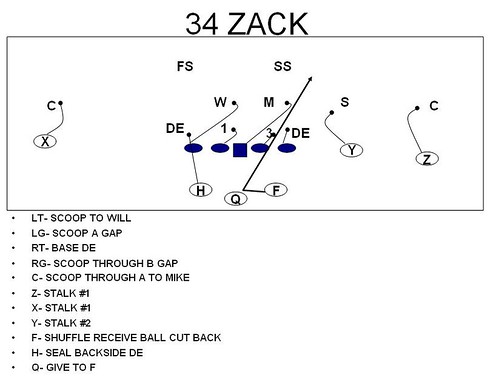
In addition to this key-breaker is the called zone cutback, "Zack".
Another 'cheap' (little time needed to rep this) play that attacks when defenses defeat your base run, this is a 3-step-then-cutback run for the back. This is especially effective when defenses overplay their fronts away from the back (antipating runs to them).

Dykes in Ruston

Dykes in Ruston

by Jimmy Watson


excerpt;
Q: What type of offensive philosophy do you plan to employ?
A: "When you start a football program, the first thing you have to do is consider how the offense and defense works together. That's something that gets overlooked a lot in football where people might have an aggressive, attacking offense and an on-your-heels defense. So what you want to do is if you want to play aggressive, attacking football you have to do the same thing defensively. Then do the same thing on special teams. So that will be our philosophy "» to attack and try to play with speed on both sides of the ball and special teams as well.
"We walked into a fortunate situation here with (Phillip) Livas being such weapon in the return game. That will be a huge emphasis for us in trying to find ways to get him the ball. There's nothing that can change a game faster than a big special teams play. I know that's a strength of our football team already.
"We want to play disciplined football "» be assignment sound on both sides of the ball. Be smart and limit penalties. Be able to execute. At the end of the spring we need to be able to feel good about operating a base offense and base defense. Our challenge will be to get our kids on the same page and we need to do a lot of teaching in the spring, but we also need to spend a lot of time working on the fundamentals."


Q. As a BCS offensive coordinator, have you spoken with other coordinators about schools at Tech's level and positions that come open as possible landing sites?
A: "As a first-time head coach, you tend to gravitate toward people who share your philosophy. We used to call it the 'One-Back Clinic,' Which is archaic because now pretty much everyone is one-back. In 1997 we started this deal when I was at Kentucky, we went out and saw Mike Tice when he was at Washington State started the 'One-Back Clinic.' Hal Mumme was there. Gary Crowton was there. Kevin Sumlin was a young coach at the time. Chris Hatcher was there. Tony Franklin was there. Mike Leach was there. All these different guys sharing ideas with each other. At that time, we were kind of the outsiders of college football. The game has changed so much that a lot of us are now the norm. We've talked through the years."


Tony Franklin to join him soon as the Offensive Coordinator

Sorting Out 1-Back Protection (2x2 / 3x1)

In this post, I am going to illustrate the simplicity and advantage to spreading the field out with 1-back formations as it pertains to securing the thrower.

When advancing the ball, the most efficient path is undoubtedly the best. The path of least resistance is often defined on the field by number superiority (more bodies at the point of attack than your opponent). This can be achieved by outflanking a defensive alignment to an offensive formation, both horizontally and by their vertical support.

An academically flexible attack based on this premise is the Air Raid 1-back philosophy by way of 2x2 and 3x1 formations. Similar to previously discussed 'divorced coverage' principles of the TCU defense, because the formation threats remain constant, you limit the variance of defensive looks you will receive simply by numbers.

With 4 receivers removed from the formation, the defense must displace players (to match) or risk being immediately at a disadvantage. Doing so leaves them with 7 defenders (11-4) against your thrower. In the box, the defense has matched the line, back, and quarterback in numbers, but it leaves virtually no help on the perimeter (speed option/screens) or any support with one-on-one receiver matchups. This Cover 0-type example is exactly why, if you plan on "spreading out", the very FIRST thing you do is have an answer for pressure/blitz (will cover in detail in later posts).

If you have any semblance of a passing game, the defense will be required to provide some type of deep support. By adding 1 deep defender support, you have now reduced the number available in the box to 6 defenders (11-5) . With your offensive line and back (5+1) you can easily account for the 6 remaining defenders. The only guesswork becomes,"who takes who"?


Through the Air Raid philosophy, the passing concepts are distilled down to elementary equations; what is launch point to be protected (timing)? No slide, zone, or calling backs in for protection, just declare who has what and it will all be sorted out post-snap.  What it essentially boils down to, when you spread the field horizontally, is that you only have to account for the defenders within "the box" (tackle to tackle).

To accomplish this, the vertical set protection is required. This is simply a retreat by the offensive linemen to put distance between themselves and the rushing defenders. If, to get to the passer, the defender first has to go through the offensive linemen, then negotiating that first obstacle only becomes delayed when the offensive line retreats. Much like we detailed in punt protection, the vertical set is a constant vertical plane that the lineman backpedals along ensuring that he never widens, chases, or otherwise out-positions himself from his assignment. This also aids in the simplicity of BOB (big on big) recognition. The linemen will pick up all down linemen, plus the middle linebacker. Since the middle linebacker may or may not be blitzing, the center will account for him wherever he is (and why whichever 2nd level defender near the center will be declared the MLB, regardless if he actually 'is' or not the actual "Mike") .  What it boils down to in a 4-man front is, the offensive line will automatically take the 4 down defensive linemen, the back will declare which side he is working, and the offensive line will declare/default the opposite 2nd level defender as the "Mike" and account for him.


In the example illustrated above, there will be a possible defensive pressure of 5+1. If the defense brings all 6, the offense has an answer and is in no reason to panic (feel pressured). If the MLB doesn't come, the center assists the near guard (usually against the 1 tech) or continues to retreat. If the 2nd LB doesn't come, the back can immediately flare/shoot into his route as the outlet receiver.

  • If it is a 4-man front, you will end up with 2 linebackers/safeties inside the box.
  • If it is a 3-man front, you will likely end up 3 linebackers/safeties inside the box.
The fronts associated with coverage (and vis versa) become a routinely simple pattern to identify, as detailed before. So with every front, pre-cadence;
  • The center will declare the front (family) and how the line intends to treat it.
  • Followed by a response from the back on which way he will be working (right or left).
  • The center then completes the call identifying the 2nd level threat opposite of the back, hence, the "mike".
The treatment of the front can be accomplished 1 of 2 ways; 'Nickel' or 'Box' calls. 'Nickel' will be any 6 man threat where there will be a 4+1 situation. 'BOX' will be any wildcard situation where the line will account for the immediate 5 rushers and all other blitzers picked up by the back and quarterback as they show.
Nothing changes with an odd front defense, the math is still the same, except that there is an additional 2nd level threat. All down linemen are handled by the offensive line, the back will declare which way he is working, center declares his second level threat (mike), leaving the remaining potential bandit accounted for by the uncovered lineman opposite the side the back has declared.

The previous example provided middle of the field support, but it leaves the defense extremely vulnerable to 4-vertical threats. This can render that deep defender nearly impotent (against 2 quicks to either side). To counteract this, most defenses will attempt to vertically constrict an offense by splitting the 53 1/3 yard field in half (or in quarters). This is the standard answer to bottle up a 2x2 formation, but requires an additional deep defender. With now 6 defenders removed from the formation (11-6), the defense is left with 5 against your passer, making the protection even simpler to recognize.
  • If it is a 4-man front, you will end up with 1 linebackers/safeties inside the box.
  • If it is a 3-man front, you will likely end up 2 linebackers/safeties inside the box.
With only 5 rushers, the offensive linemen can completely account for the threat and 'box' it all. Any wildcards or late prowlers can be recognized easily by the back, if needed.
When segmenting the field into consistent looks, the potential uncertainty (things that will foul up execution) becomes manageable, almost predictable. This is pivotal in efficiently implementing a game plan as well as simplifying the corresponding practice plan to accompany it.

This may SOUND like a lot to account for, lots of interchanging parts.  However, when you live in these formation sets, you'll begin to see that there really aren't a whole lot of fronts a defense can threaten you with and that protection sorts itself out fairly intuitively with your players.

By spreading a defense out, the offense can begin stretching the field to breaking points. When a defense breaks, the offense scores.

LA Tech: Sonny Dykes

Congratulations to Sonny Dykes on his ascension to head coach of Louisiana Tech!

I had already penciled in a visit to Ruston this Spring, but now its a definite to check out their offensive implementation.

Arizona under Dykes, particularly under the pressure of the past two seasons, has streamlined their Air Raid approach and established an efficient method of ball distribution.


Some more background readings on Dykes, Art at trojanfootballanalysis does a bang-up job assessing the overall production over the years;


http://www.trojanfootballanalysis.com/wp/wordpress/?p=1760


.....as well as a brief overview of what Dykes will likely be bringing with him in 2010;


Sonny Dykes AIR ZONA

Screen Drills

Probably one of the reasons I LOVE the Air Raid is because of the simplicity and efficiency of the heavy screen game utilized. Nothing gives a defense more diarrhea like an offense that can attack multiple areas of the field in an instant.

Secondly, you don't even have to be able to block to make screens work. Hands down our best play this year was the 41/51 fast screen (and we 'technically' weren't Air Raid), where we would average 8 yards a pop (and we threw a lot of them). It is a simple double-play-at-second-base-baseball-throw (Darin Slack's C4 disc 3 has some great drills for this under center and from the gun), to a split receiver giving a 2-step stem then working back to the quarterback.

Screens are an amazing way for your players to gain confidence in the offense immediately (can master the entire screen game in one practice) as well as establish an intense practice and playing tempo. The viciousness of these fast hitting plays can devastate a defensive line and allow your offensive linemen to dominate with cuts, lateral movement, and otherwise frustrating the beejesus out of the defensive front.

Here are some drills (i.e. "cage drill") for reinforcing the proper footwork for fast (1 step NOW!), rocket (fake 3 step action), and solid (zone run action for 3 steps) screens on the perimeter.

screen @ Yahoo! Video

Revenge of Mumme

just clips of TD throws from NMSU in 07

90 Shallow Clinic

Enjoy a clinic from former Caddo/Desoto Parish Head Coach, Jerry Byrd Jr., of Shreveport detailing the 90 Shallow series.

http://www.youtube.com/watch?v=PNHt4HnXnxg


H/T to James Thurman for the heads up on the video.

Air Raid: Settle & Noose

trying to make use of my now defunct GoogleVideo account (argh!), here is a great visualization of the settle & noose pre-practice drill for quarterbacks and receivers


with examples of the big hitters of Air Raid, Shallow & Mesh


Top