ads

Slider[Style1]

Style2

Style3[OneLeft]

Style3[OneRight]

Style4

Style5

TCU Defense Explained

It seems the one thing people want to see more of
tcu
is TCU’s split-field coverage principles. 


I don’t blame them.  It is an efficient system for distilling defenses down to their root element and provides a framework built-in to handle any offensive formation.  I’ll reiterate that WHAT they do is actually what all other defenses do.  It is the system that Gary Patterson and Dick Bumpas developed over the last two decades (through necessity) is what is important.
TCU_Tank_Carder_medium
Since its just you and me here, I’ll let you in on a little secret…..but don’t tell anyone else, okay?


First 3 hours of Gary Patterson explaining how it all came about, how he installs it, and how it will be applied (with a film review of game and practices).


Previous entries:
TCU's 42 Nickel Coverage & Front Coordination
TCU's 42 Nickel Blitz & Coverage Concepts
TCU "2 Read": Adaptation to the Spread (2x2)
TCU "2 Read": Adaptation to the Spread (3x1)


** be sure to check out these blogs as well **


http://footballislifeblog.blogspot.com
http://www.coachhoover.blogspot.com


Unbreakable Fire Zone

As touched on earlier this year, Manny Diaz makes a great point when he says that his fire zone “is the safest thing I can run”. Coupled with pattern-match principles it allows the defense to congeal itself into whatever form the offense runs like a veritable coverage jiu jitsu.

 
The point of this post will be to illustrate the flexibility the concept provides where most blitzes would ‘break’ or require a check out of. We will concentrate on how coverage defenders should respond to challenging patterns from typically stressful formations of 1-back and empty. This is an element that we enjoy discussing here; the evolution and adaptations within the game of football.

 
The key to the success of this type of defensive application remains the teaching methodology that carries concepts over from Cover 1, to Cover 3 pattern match, to Rip/Liz match. The combination of these fundamentals are what the success of the fire zone is built upon. Neglecting or not thoroughly teaching the roles will limit the effectiveness of how players operate within the fire zone.


For the sake of discussion, we’ll narrow the application to the “NCAA Blitz” fire zone that everyone runs, but keep in mind, just plug-and-play personnel groupings because it’s all relative regardless if it is a safety, backer, or lineman taking on the role of one of the underneath defenders. For the sake of clarity in this review, terminology varies from staff to staff, but I will refer to the wall/flat player as the ”SCIF” player and the middle hole/hook player as the “final 3rd” defender.

 
As we’ve discussed before, any defense can line up against 2-back pro formation, it’s what the defense has to become when confronted by 2x2 or 3x1 sets that determines what the defense actually is.

 
The best way to conceptualize the coverage matching is that you will zone into the pressure / man (match) away from the blitz.

 
2 x 2

With the fire zone you’re essentially getting 3-deep coverage, a seam player, and one final defender to match the third receiver to either side (or cut any crossers). Because 2x2 is one-back and essentially a ‘spread’ set, the Rip/Liz check becomes the standard way to aggressively handle the two seam receivers. Instead of passing off receivers or spot-dropping, letting voids develop – this method ensures the routes will be accounted for while still avoiding the inflexibility of true man coverage.


How the remaining back will be accounted for is all that really differs from Cover 3. This also plays into how shallow crossers will be handled (with inside verticals compensated with Rip/Liz). Without the ability to funnel the back between two linebackers, you only have one backer (and lose the ability to ROBOT away inside routes). This essentially has the middle hole player assigned to aggressively match the back (who is #3 receiver to whichever side he releases).

2x2 out of a 3-deep concept (fire zone) will be handled simply by Rip/Liz in all cases. This remains true unless a receiver immediately breaks inside under 5 yards. With inside breaking routes, the defenders will not chase but alert the final 3rd player that he has a route approaching (“cut” as the hole defender). The final 3rd defender will receive an “UNDER” call from one of the outside defenders (an inside breaking route under 5 yards). This is a post-snap call on Rip/Liz to zone off into a 3 deep principle (#1 or #2 takes route inside).


Typically with a shallow, it is paired with a back flaring to the side of the field where the shallow originated to serve as an outlet receiver. This makes for an easy exchange, just like a “rat” call in Cover 1. The SCIF and final 3rd player just replace one another’s receiver, though the distribution remains consistent (the shallow becomes the 3rd route, the flare is the 2nd route, and the post is the 1st route in the distribution).


A more challenging route package for matching would feature the shallow to the same side as the flare. In this example, both SCIF players would carry #2 vertical with the Rip/Liz rules and the final 3rd player would pick up and carry the crosser after receiving the UNDER alert. With all threats leaving his area, the away-side corner would sink and high-leverage the dig route.

 
3 x 1

Trips formations can be a bit more challenging to the fire zone because it can immediately out-leverage defenders by alignment (3 receiver side). Even though it presents a horizontal stretch, the 3 receiver set can be handled using the same method as the zone-push concept, “Mable”. The first outside receiver would be manned by the corner. The second and third receivers will be (banjo) matched by the SCIF and final 3rd player underneath with the corner to trips manning on the #1 receiver. The away-side SCIF player would immediately look to match the back or whoever became the #4 receiver in the route distribution.


Here, just like in 2x2, the shallow by X precipitates an UNDER call by the corner letting the final 3rd player know he has a receiver crossing the formation (becoming the 3rd receiver / 1st receiver inside to trips) to cut. The away side corner would high-shoulder squeeze the shallow into the formation until picking up the (meshing) drag by Y. This leaves the away-side SCIF player free to jump the back releasing to his side.


The previous two examples showed #2 in the trips being the first underneath out route. What happens if #2 releases inside (such as with spacing shown here)? The H receiver would become the first receiver inside, with the Y being the first receiver outside. Since the H is no longer the #2 route in the distribution, he is passed off to the final 3rd player. The SCIF player matches the Y as the first of these two ‘outside’ underneath.


Empty


With empty, the only check required would to be ensure that the rush is coming away from the 3-man surface due to leverage issues. With two receivers away from trips essentially in man coverage and zoning to the trips, it would require the zone defenders to the trips side to be afforded the best possible positioning on the two inside receivers (just flipping where the overload is coming from).  Just like against any trips set, the trips-side defenders would Mable (zone push) into the route dispersion. The away-side would aggressively man the remaining 2 receivers and retain the middle-of-the-field safety.


** PS **
The slot coverage post is coming.  This pattern match post just happened to be ready first and I don’t want to sit on anything that could help.

Also, if you haven’t figured it out already, our former YouTube account that included many of the cut-ups featured in previous posts has been deleted by Google/NFL Properties.  Hope you downloaded / picked up on those video illustrations while they were up.

Bama Defensive Fundamentals


We have some things in the works that may prove worth the wait, but here’s our tribute offering to you to TIDE you over….

Fundamental defensive work from Alabama

More videos here Youtube Channel


Bama

[download links]

Not much has really changed in the last 15+ years - it is a concise defensive system to address everything an offense can present (you should be able to pick up on how Saban really only treats a few personnel / formations and everything else stems from that).  Its actually a pretty basic look that gives you a full toolbox of answers.
Of note (things you should check out)
2008 Alabama Defense

if you don't get the above joke ( you'll need to click here and watch the whole thing)

Exploring Caper’s Nickel

Something that has intrigued me this past year is how more and more teams have been using untraditional personnel groupings (nickel/dime). Now what they do out of these packages isn’t all that mind-blowing. What I do intend to learn from this trend is
  1. how the front integrity remains sound (how the gaps are accounted for) and
  2. how their proliferation relates to teaching methodology (it remains consistent with everything they already do).
Now this post won’t contain any answers – I’m just passing along some things that have piqued my curiosity. Be sure to check out blitzology if you’re interested in getting practical insight now.
I am certainly open to any insight. I am most intrigued by how Dom Capers has been using this (loved his work with the Panthers, plus he was with Saban in Miami) and in particular, the use/technique of the 2 defensive linemen (not ‘Psycho’). I am more intrigued by this because of how the DTs handle the interior gaps as well as the use of standup linebackers on the edge (that puts you in a real 42 because that is how personnel is used, anyway, with no true defensive ends in great supply). TCU has been doing this more and more against 1-back gun offenses because there is little threat of being 'blown off the ball' or out-leveraged when standing up (to the field).

I feel there are certain known factors that provide clues towards what is actually taking place and that would be as follows;

  1. The offensive personnel groupings have no bearing on when these are used. 21 / 11, pro, double-tights……it makes no difference.
  2. I am not quite certain how much ‘field’ and ‘boundary’ has any true relevance concerning the tendency with these groupings. The NFL hashes only give you a little over 9 feet of difference between the area of the field, so I don’t believe there would be a true game plan based on this
  3. Because of the assumption of #2, I would believe that pressure is designated by formation splits and/or back set, as this would be the better indicator of protection.
  4. #3 gives credence to the effectiveness of fire zone/blitz pressure (catch man) coverage, where it can provide ‘unbreakable’ answers, rather than playing double coverage calls (pro/twins).
  5. The modular approach to the fire zone (hot 3, SCIF, deep hole, etc) means you can plug-and-play any defender into a role to come up with a myriad of options to cover 5 receiving threats. It is this approach that I feel will be what most of us (coaches) can use to improve how we teach the game and include more players in the game.
  6. With only 2 defensive linemen in the front and the center never being covered (usually double 3 techniques) , my completely unfounded assumption would be that these guys are playing a heavy (2 gap) technique (which is really becoming prevalent). This also aides in muddying the Mike declaration for 5 and 6 man protection. Though this initial thought may be incorrect or their reads have become incredibly effective in controlling the playside gap. Actually, it is how the 2 DL contribute to controlling the front that has me the most intrigued because it doesn't appear that the 5-7 technique backers are that integral to gap-integrity (as in, they are either controlling the gaps with the pirate stunts associated with fire zone or are looking to spill everything to the SCIF or sideline in man).
Of course, any or all of these assumptions may be incorrect, but if I can find anything we can take away from this I’ll pass it along. It goes without saying that the NFL (game) is primarily about key players that allow you to do things most every other team cannot. Meaning, a good portion of this could be just the by-product of having freaks on your defense.


The constant at the lower levels (particularly high school) is that :
  1. Your best personnel IS your best personnel, meaning your ‘base’ defense is usually your only defense and if you can sub with considerable competent depth on defense, you are in the minority.
  2. Your effectiveness on defense is relative to the quality of opponent you face. If you face offenses that are relatively 1-dimensional and/or do not vary much on down and distance, then situational game planning with personnel groupings like these can be hit or miss.

Additional thoughts....
Semi- related to the Capers nickel exploration, is just an empty adjustment Capers used with Saban at Miami, “Rain”, that follows the same principles. This is a 5-man check-blitz premised out of 0 coverage, but could be used with fire zone 3-deep / 3-under coverage.


The beauty of this is that you’re going to get 5-man protection with no back, so how you declare the mike (extra rusher) is crucial. With the double-3 techs and no real Mike to be found, you give a lose-lose situation to the offensive line with no clear picture to where the pressure will come from.

By presenting a rush of 4, the quarterback would either check to the most dangerous threat or away from the hot. Either way, the defense will be sending two bandits to each B gap, having the blitzer to the side the center does turn his shoulders to (the slide side) pop out and become the “hot 3” player in the hole. This leaves the away side B-gap blitzer a free pass to the quarterback against the man-protection side of the formation (G & T vs edge rusher and DT in A).

Addendum to the Additional Thoughts...
ahem......actually nothing to do with Capers, but following the same meme and how it is used elsewhere. While I really don't have problems 'controlling the front' with the standard 5-man fire zones because it remains sound. I just know that many DCs have been teaching their interior defensive linemen with a variety of techniques over the past 5 years (bridging the gap between 1 gap and 2 gap read) creating more versatile possibilities in what you can pull off in situational defense.


Manny Diaz: Bulletproof Fire Zone


"I always think that schemes are overrated....We're going to attack out of a multiple array of fronts. If I had my druthers, I'd like to play a 5-4-5, which you're not allowed to do. But I want the offense to feel...like we've got about 13-14 guys running around. We want to look like we have an unfair advantage."

The youth movement injected into the University of Texas program has generated a lot of buzz recently. The hope is that the new found energy translates to on the field production after a lackluster performance during the 2010 season. One reason to be especially excited is that replacing legendary defensive mind, Will Muschamp, is Mickey Andrews / Chuck Amato protégé, Manny Diaz. Diaz’ eager hustle, passion for fundamentals, and keen attention to details is apparent in his body of work through NC State, Middle Tennessee, and Mississippi State and are what have propelled him on the fast track to success. Having never played college ball, Diaz doesn’t get caught up in over-complicating the game, but keeping his scheme idiot-proof.


“Offense and defense is about asking questions and having answers.
When an offense presents something, the defense has to answer.”

With the advent of the versatile 1-back gun in today’s offenses, defenses need to account for so many attacks that they must figure out what exactly they are looking to defend. Diaz believes that to stay ahead of the curve, to, a defensive coordinator needs to force the ball to go where he wants it to go, rather than attempting to just ‘defend the whole field’. With this approach, you are left with even more reason to include fire zones.
 
FIRE ZONING THE RUN GAME

“Dare the offense to run – then make them run into something they don’t want to run into”

Throughout the 90s by the way of Miami, defenses transitioned to the mantra of speed, with the defensive ends becoming the most disruptive players on the field. The more offenses game planned and tried to deal with these athletes, the more they realized they just couldn’t block those guys. This is what has brought us to the current flavor of offense, where they don’t even block the defensive ends (read game).


“Don’t let them make decisions – with fire zones you make all the decisions for them”

Combating the gun option, Diaz feels the fire zone is the perfect RUN defense because of the key-breaking look it presents. In most fire zones, you will overload one side of the ball with 4+ rushers with the backside dropping into coverage. For a quarterback, you are faced with a confusing picture.


If you read the backside end on zone-read, a defensive end that crashes (attacks the back) will tell you to pull the ball and run. If the backside end hangs or stays lateral, the quarterback should give to the back.


The problem is, against the fire zone, “none-of-the-above” is the answer. As you see in these pictures, if a quarterback sees the backside end hanging (not attacking the backfield) as he would if he were dropping, the quarterback would give to the back, who would be running straight into the teeth of the blitz.

With the fire zone, Diaz feels he can get the best of both worlds as it is an 8-man front with middle-of-the-field support with 6 defenders covering 5 potential receivers.

“Its just Cover 3 with a hook player blitzing – that’s a fair exchange.
It is the most stable thing I can run”

A large part of the success Diaz has experienced with fire zones is due in large part to the way he employs them. Simplicity is the key, contrary to most defenses, Diaz believes in spot-dropping with his 3-deep, 3-under to prevent his defenders from thinking or making mental errors. In this post, we explore how he defines and installs his foolproof approach to the fire zone.

FIRE ZONE
Much like how Nick Saban installed his middle-of-the-field coverage principles (curl-to-flat / hook-to-curl players), Diaz teaches ‘jobs’ instead of specific instructions. There are only 3 positions to be defined for this to work. The only thing that a defender needs to know is which one of the three will he be (and adhere to the simple rules for each).

The basic 3 deep fire zone features a long sticking defensive line away from the blitz with two backers or a backer and a defensive back rushing. The simple rules of this scheme allow you to mix and match who will be the rushers.

 Diaz has found that when running fire zones, they eliminate front calls (less for the defense has to worry about) with the only thing the defensive line has to know is that there is a fire zone going on and which side the blitz is coming from. When you know that, the line will just align away from the gap they intend to stunt to.


The rules and integral pieces of the fire zone are as follows:

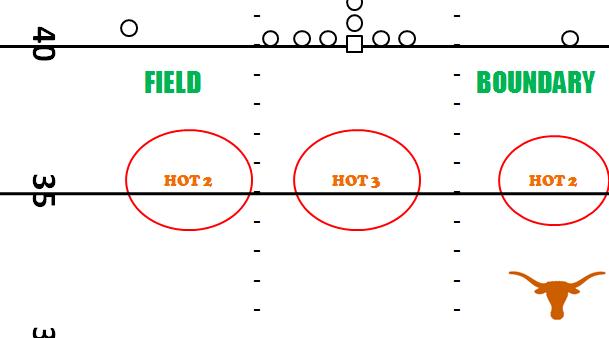
“Hot 2 to the field”
Defender is a curl-flat player. “Hot 2” means #2 receiver will be the hot target versus blitz (receiver will stem 5 yards and turns around against blitz). This defender simply has to control #2 (or whoever becomes #2) hot versus a pass read. The landmark will be 2 yards outside the hash (or the hash to the field in high school).  If the quarterback continues to drop, he will get to 12-14 with his eyes on the quarterback.  Versus a run read, this player is the contain / force, and will outside-in leverage the ball.

“Hot 3”
This is a simple job.  On pass, he is simply to get to the middle of the field (regardless of where #3 is) defending space in the hole. If the quarterback continues to dropback, he will fall to a depth of 12 yards.
Versus the run, he simply has to recognize who #3 is and relate to him and spill with inside-out leverage.
Versus option, he is a dive player only.

The Hot 3 player is the only player that can exchange assignments with a defensive end (called “switch”).
Switcher – is the linebacker away from blitz that will be the Hot 3 player (DE away is the Hot 2 player). If there are two receivers removed, the DE can’t possibly play the curl (Hot 2) so the Hot 3 player (linebacker) will make a “switch” call. All this does is ensure that the offense doesn’t make you check out of the blitz or out-leverage you. The Hot 3 and Hot 2 will switch assignments and the linebacker will walk-out and align inside #2.

“Hot 2 to the boundary”
This player will drop to 4 yards outside hash (2 yards outside the high school hash) to the boundary. Like the other Hot 2 player, he will drop to 5 yards against quick step and 12 yards against drop back pass and will be contain on run with outside-in leverage.

Usually the Hot 2 to the boundary will be a defensive end (brining field pressure). The coaching for the defensive end is simply, “Just go backwards” – that’s it.  When in the boundary (“hot off of #2”) if #2 is in the backfield (i.e. some type of 3x1 to the field), this player must tackle him if he runs an inside run. In the boundary, this technique is exactly like you would play as an outside linebacker in a traditional 44 defense.

*Once you declare who #3 is, all of the pieces fall into place and there remains no more thinking involved in the defenses.

Outside Blitzer
When bringing extra pressure with backers and backs, one of the rushers will be the outside (or contain) blitzer. This player is geared to get after the quarterback, but must recognize how he fits into the blitz. On back flow away, he will have the quarterback outside-in. With flow to, he will tackle the running back (on play-action or not). Versus lead-option, this blitzer will immediately take the quarterback (as the Hot 2 player outside of him will take the pitch).

Diaz will teach how to drop to the field for a month to build competency, then will acclimate his players into counting guys and understanding the support fits against the run game. The beauty of this approach is that the fire zone now becomes an “offensive play” for the defense and can be practiced during 7 on 7.   The rationale here is to install it (all of it) quickly and just run it over and over to work out the details on the fly.

Effectiveness of Blitzers

The most underrated element to Diaz’ approach to fire zones, is the coaching of the blitzers. With the fire zone, the defenders are attacking PEOPLE (not gaps).
The stunts tell the players how to penetrate, then attack the passer. The mindset here is to treat blitzers like ball carriers (the blockers are tacklers), that after taking the proper path, the blitzer should “find the open grass”.
 
Instead of telling a player to “blitz the A gap”, he will sell it as “you blitz the guard”. The philosophy is to take the path of least resistance; the quickest way to disrupt the passer. The blitzer will fight the soft shoulder of the blocker (not try to struggle where the blocker is strong). If the blocker sets hard inside, the blitzer has the freedom to bounce his path and fight the soft (outside) shoulder and take the easiest way to the quarterback.


COVER 2 CHANGE UP: “TRAP”
With any good attack, you need a counter-punch, a change up. With playing MOFC coverages such as Cover 1 and 3-deep fire zone, it is important to keep an answer up your sleeve for when the offense gets wise to what you’re doing. The TRAP fire zone is strong where fire zone coverage is weak. With Trap Coverage, Diaz uses man-match coverage (not spot dropping….except for the flat defender).
ScreenShot238

Trap fire zone is just a changeup that will have two blitzers outside the Mike linebacker (which can play havoc on protection that adjust to the MLB). Just as detailed above, once you define the jobs within the coverage, plugging and playing defenders can be simple.
ScreenShot237


“SEAM PLAYER” – Defender will be inside and on-top of whoever is ‘seaming’ unless he goes to the flat (look up inside cut to the curl).

“BUZZ / TRAP PLAYER” – This will be the strong end to the call and will be the buzz defender (playing from inside-out position) that shoots to the flat away from the trap defender. The corner to the blitz side will be the trap defender (corner is playing from wide position). This corner should be trying to show that he’s 3 deep as he is in fire zone coverage, but will be hanging on the flat. The rationale here is to make it look like a blown assignment by the corner. He will plays the gap inside #1 on run. As a trap player, the corner will rob the slant or he will carry #2 on the wheel. Again the simplicity here is what is important; when the trap player doesn’t even move, he ends up in a better leverage position.

“½ FIELD DEFENDER” – This will simply be the backside corner and safety. The rules are simple, seam #1 by remaining inside and on top #1 unless he goes to the flat (even on a shallow by #1). The deep half player will act as the eyes of the corner. Versus a Hi-Lo (CHINA) concept, the safety yells, ”CHINA”, so he can match him. If the offense comes out in 2 backs the safety will seam the back away from the blitz (if he blocks or is free releasing)
Because you have 4 underneath defenders, there is no switch call in trap coverage.
With trap coverage, there are some basic guidelines to ensure everyone is on the same page and aligned for success:
  • Vs empty…..LB has to walk out
  • VS 1 back – MLB has #2 and the WLB has #3
  • VS 2 back – WLB takes #2 weak or #3 strong
 
As you can see there is nothing revolutionary to what Diaz is doing, but the method he uses to simplify his scheme and is something that can be picked up by young players and develop a hyper aggressive defense that appears multiple and complex but remains easy to digest.


Additional Resources:
2010 Ole Miss vs Miss State
2010 Arkansas vs Miss State
2010 Bama vs Miss State

Coach Hoover: Defending Oregon Spread


There are some extremely insightful and in-depth articles created by Coach Hoover leading up to the National Championship Game.

43 vs Oregon Spread (DL play)

43 Fire Zones vs Oregon Spread

43 vs Oregon Spread (LB / Nickel play)

43 vs Oregon Spread Bash and Midline

43 vs Oregon Spread (DB play and coverages)


Be sure to check out his subsequent series on defending flexbone option with the 4-3
DT Play
DE Play
MLB Play
OLB Play
FS/SS Play
CB Play


SITE:
For updates and goings on or what not, feel free to follow (this site) on Twitter at
http://twitter.com/#!/GetBack2Fundies


or join the Facebook group (instead of following Brophy) at
http://www.facebook.com/group.php?gid=147052308657775

Bo Pelini: Spinner Update


The Blackshirts have returned!

After dismantling an explosive Missouri offense this weekend, Bo and Carl Pelini are resurrecting the Nebraska defense of old.

As discussed previously, the dime pressure "Spinner" package was used to perfection to disguise and attack the rhythm of the Pinkel offense.


A good article with a few choice interviews, "emptying the notebook" alludes to the effect of this scheme.

The Huskers used their normal personnel up front but worked out of a three-man front, taking defensive end Cameron Meredith out of a three-point stance and using him as a stand-up outside linebacker. Along the line, the Huskers spread out their linemen, putting bigger bodies along the edges.

“They lined up their D-tackles on our tackles,” Missouri center Tim Barnes said. “Having those guys out there, I know it’s different for our tackles, having that much extra weight. I know they’re used to faster, quicker guys.”
“We worked that three-man front all spring and all fall, just for this game,” defensive coordinator Carl Pelini told reporters after the game. “Our guys were ready to execute it.”


Also, noting catch-man pressures (from consistent pre-snap coverage shells) as the trend many defenses will look to as an answer to "the spread" offensive game. Nebraska HAS been playing a ton of Cover 1 this year, which was a trademark of former DC, Charlie McBride.

“They played a couple different coverages, but for the most part if was all man-on-man,” receiver T.J. Moe said. “Once you hit 5 yards down the field, no matter what the coverage was, it was you against him. We didn’t do a good enough job getting open today.”

On a few occasions, they dropped a safety down to play Cover 3, but primarily were in Cover 5 (2 deep man-match under) allowing the underneath defenders to aggressively attack the receivers with help behind them.

Defensive Forecast

I just wanted to drop a line and document a trend within football, though I don’t have a particular conclusion in mind, but one you should be able to witness as it takes place during your favorite game. This is no profound Michael Lewis “Lawrence Taylor skill set arcing to the deliverance of a Michael Oher”, merely just a broad capture of a recent trend that could possibly lend itself to a forecast of things to come.

In back-and-forths I’ve been having with football guys I esteem greatly (some are contributors here) for the past year, and touched on a little in comments at smartfootball.com, my assertion is that the growing trend in football will see a defensive adaption featuring more off-man match from 1-high (or zero ) coverage [with a majority of this played out of untraditional nickel/dime packages].

As detailed previously in the Charlie Strong Orange/Tan package, Nick Saban Cover 1/9 Rat, Bo Pelini’s Spinner/Nickel Bomb – the off-man coverage (from primarily a 2-high shell) allows for efficient disguise, protecting against 4-verticals, while accommodating superior numbers against the run and maximum pressure on the passer. If I can ever get around to articulating my thoughts (with sexy powerpoints), we would also have these trends noted from Gregg Williams, Dom Capers, and Rex Ryan.

It all essentially boils down to the pattern-match concept and how it has/is being used as an adaptation method. “Pattern match” really is just man-match (by the time you get 1.5 seconds after the snap it all ends up being the same thing). As detailed in the Saban series last year, man coverage married to zone coverage with ‘pattern match’ is not all that much different; the response will be nearly identical. The growing trend in playing “pro-style” catch man coverage technique is what accommodates the “untraditional” personnel matchups and the deep 1-high safety with pressure. This is a look that will become increasingly more familiar as you watch football this season.

The thing is, in the 80s and before, the game primarily was founded on exclusive man-to-man, 1-high defenses (because the traditional offense didn't align for a vertical/horizontal stretch). These defenses were WYSIWYG and ‘primitive’, usually with bump-and-run and 8-man fronts to match the standard 2-back offenses. As the trend shifted from 1-high MOFC to 2-high MOFO zone defenses, offenses counteracted with multi-faceted 1-back run games (with running quarterbacks). We arrive to where we are now, where the old ‘bump-and-run’ coverage is considered a barbaric dinosaur and press-man is welcomed by pass-first offenses.
Doing my best Ron Jaworski impersonation here, lets go to the tape….


A few of the elements I believe that are contributing to this paradigm are as follows:

Rule Changes – With continued rule enforcement (for player safety) at the higher levels of the game, defenses become hamstrung in their ability to be physical. Whether it is limiting receiver reroutes/leverage, horse-collaring, helmet-to-helmet hits, hitting near the sideline, or touching a quarterback’s head, defenses are being painted into a corner where they have little recourse against offensive plays. You can sit back and let offenses run their routes and try to respond to it after the fact (ala Tampa 2), or you can choose to play the percentages and 1) neutralize the running game with a numbers advantage and 2) force a quarterback out of his hitch with +1 pressure and/or 3) leverage receivers out of throws down the field. The trend we are seeing favors the latter choice and time will tell just how the offense will counteract this approach as it catches on.

Professional Control Group – The pro game isn’t the end-all of game development. The borrowing/learning of concepts between BCS college programs and the NFL resembles more of symbiotic relationship rather than that of the linear trickle-down that is widely believed. As with all elements of evolution, the strong (concepts) survive and those that don’t adapt become part of a dying breed. The method of the higher levels of the game boils down to surviving as many downs/snaps as possible. The more downs you win; the more games you’re likely going to win – the greater likelihood you still have a job in the morning. This cut-throat (survival) approach is what necessitates the 60 minute game be reduced to isolated situations. EVERY snap is its own war, its own unique opportunity to swing the tide of the game. Dial up the perfect play and you have the potential to break the game wide open.

This concept should be quite foreign to most people because we’re all accustomed to seeing the same 11 starters on the field throughout a game, so nothing really is changing. Especially in high school, where your best LB is also your best Safety and he may also be your best defensive end. Substituting this player would only make your chances worse on a down, not better; you don’t have an endless supply of specialists and are lucky to have 11 full-time starters. Consequently, you can sit in one personnel grouping (or two) all game and just play the odds because, quite frankly, it beats the alternative.
Example of special personnel grouping
What we’re talking about now is specialization. You have players who can specialize in certain functions (down and distance, play types, etc) and excel in those personnel packages. It used to be where the defense just matched offenses based on personnel. If the offense had 21/12 personnel in the huddle, your based defense was on the field. If the offense had 11/10 personnel, your nickel package came in the game. Anymore, we’re seeing defenses using personnel not so much to match the offensive players, but the specific situation within a game (though offensive personnel will mirror the situation). This was touched on previously when introducing the study of ‘untraditional use’ of nickel/dime uses in the NFL. Even though dime personnel is not warranted to match an offensive formation, it is used anyway (despite possible physical liability in matchups) for coverage/pressure. The trend was noted with Pelini’s Spinner package, but is also gaining popularity with Dom Caper’s “Psycho” groupings. As a side note, “Psycho” was introduced with the justification to the media that Capers simply didn’t have defensive linemen because of injuries late in the season. Even after the injury bug subsided, he continues to use it heavily between the 30’s primarily for 1-high, off-man pressure.

Roster Limitations – The trend outlined above, of maximizing the use of the entire roster with multiple personnel groupings dove-tails into the equalizer more distinct in the NFL (but affects the NCAA by way of recruiting classes); roster limitations. Since there is a finite level of talent on both teams in a game, you have to figure out how you can do MORE with less (than your opponent). The team that can win a war of personnel attrition either through prolonged exertion (wearing the opponent out) or by utilizing a deeper portion of the roster (is your #4 receiver better than our dime/money defensive back?). If your team simply cannot match the personnel groupings they are faced with, you will likely get the short end of the stick on that snap (which could prove to be a turning point in the game).

It, again, reduces the individual situation down to one-on-one personnel matchups and improving the likelihood of winning those battles. This is where the “Wildcat” trend comes in. Especially in the NFL, where the 53-man roster is stretched so thin, your roster has to be able to (counter) match the roster of all your opponents. If you are equal on 47 of 48 roster spots, but your opponent has a “quarterback/receiver/running back/punt returner” as their 48th man, how are you going to account for that? This is where a stockpiling of safety/corner hybrids comes into play and then leads to their gratuitous use on downs not warranted previously. You no longer end up with full-time offensive / defensive players. The result is you have a situational offense/defense that tactically specializes in specific scenarios.

Attacking protection – Because defenses will be compelled to use these multi-position athletes, you can now begin opening the door to a myriad of pressures and coverage-matching. You not only have a defender able to cover receivers man-to-man, but also have a better matchup against backs (than a linebacker would). This also blurs the front identification needed for protection (as well as bringing considerably more speed to the pressure than most offensive linemen are able to match) – is that #33 nickel on the edge now considered the “Mike” do you adjust protection to the bandit(s)? What happens when any one of a handful of guys near the box can be considered a potential rusher? This goes beyond the basic premise of nickel/dime packages – because the offensive personnel in the protection will not be accustomed to seeing these types of looks (7 man protections typically employ a TE. If there is a TE, you usually have at least 2 or 3 linebackers. If those 2 linebackers aren’t there now, how exactly are we going to handle this front and WHO should the offense expect to match the receivers?).

This is just a thought that has been keeping me up at nights and something I’ve been seeing a lot of for the past 18 months. It used to be that defenses were crazy to try man-coverage on pass happy spread teams, especially with a runner at quarterback. However, more and more, I’m seeing this old look adjusted to fit the current game. I’m not even a “man” guy, but I have seen the benefits from doing things differently and now even prefer the ‘catch-man’ technique and how it opens up a world of defensive possibilities.
Now, I'm not suggesting that defenses will be playing a ton of man-coverage exclusively, just that you can expect to see more untraditional personnel groupings on the field and the way more and more teams will go to acheive pressure will be from off-man coverage (moving away from fire zones).
Feel free to rip me a new one in the comments section…..

BRONCO/SCIF Player

As covered many times in various forms before, the fire zone blitz concept is prevalent in today's game. In this post, we'll cover probably the most under documented aspect of it, the SCIF player. Losing an underneath zone defender to pressure may cause some 'fundamentalist' thinking DC's to lose sleep... "how do you account for the four underneath zones"?

The 5-man pressure package can seem complex or superfluous to many folks, treating it as an alien concept. If you already pattern-match from a MOFC, then adapting to the fire zone for your players and philosophy becomes a natural extension. When players understand zone coverage as it relates to pattern distribution, plugging and playing them into similar roles becomes feasible because of the shared skill set.

When running a fire zone from a coverage standpoint, not much will actually change in the secondary. The fulcrum to this scheme will fall on the integrity of the SCIF/Bronco player, who controls the seams and matches the second receiver in the distribution. This player can be anyone within realistic alignment position (safety, linebacker, defensive end) near the seam. The beauty of the fire zone is its flexibility, you can bring anyone to match / fulfill the 3 underneath players.

If the SCIF player is a member of the secondary, the adjustment is extremely simple. If it is being run out of a 3-man / odd front, there usually is no need to drop linemen to create a fire zone, so you would typically end up with a Dog, Backer, or Safety as the SCIF player. Whoever it may be, the rules and technique will remain the same. The goal is to control the seams, the area between 2 yards inside the hash extending out to the numbers. You are essentially expecting a sack or force a short throw (below the conversion down) and outside (difficult).

This SCIF player must control the seams, which will be immediately threatened by the #2 receiver. On the snap, the defender will keep his eyes on the quarterback, bounce his feet (much like a Cover 4 safety), and easy pedal out with a slide step. Once recognizing drop back action from the quarterback, his eyes will snap to the #2 receiver and continue to slide for depth to stay on top of #2 at a depth of 10 yards.

Because this is a pressure package, the throw, if it occurs, should be quick (under 2 seconds) and not allow the quarterback much time to process through his progressions. If the quarterback's shoulders are directed at the seam, the SCIF player should be expecting an inside or vertical route, to which he has out leveraged the receiver (eliminating the throw). The SCIF defender should know that once the quarterback's shoulders go OUTSIDE the seam (exaggerated toward the flat), there is no way for him to progress back inside (and even if he did, the 'final 3' player would handle it). Therefore, if the quarterback's shoulders turn outside the seam, the SCIF should work parallel (expand width) to the numbers (sideline).
  • If #2 pushes vertically on the seam, the SCIF should catch at 10 yards and carry. He is essentially looking to play 'catch' technique on a vertical stem by #2 with inside-out leverage.

  • If #2 runs a speed out, the SCIF should slide to his outside foot and bust to the curl route, expecting the #1 receiver to be there on a curl-flat combo. The SCIF should not jump the speed out (but anticipate #1 will be the #2 after the pattern distribution).

  • If #2 breaks inside (shallow) underneath 10 yards, the SCIF will attempt to deliver this receiver to the final 3 player in the hole with an outside leveraged collision.

  • If the quarterback's shoulders open AWAY from the SCIF player (he is backside), remember, the quarterback won't have time to work back inside, the SCIF should slide parallel inside, no further than 2 yards inside the hash and help squeeze the ball with the 'final 3' player.

Where things get dicey is when you involve a lineman (end) in coverage as the potential dropper / SCIF player. This really becomes a run stunt because being away from the pressure overload, the defensive end's interior linemen will be stunting to his side. The nearest lineman will be looping to his "C" gap contain responsibilities, leaving the SCIF defensive end as a potential "B" gap filler. Below are some reinforcement drills on how the SCIF DE will mirror the back (load/flare) with leverage. The SCIF DE should always think of himself as a run-player FIRST, and a dropper only if there is no run action by the back.

Developing A Defensive System

Similar to its offensive system, a team should have a fully dimensional defensive system that is both function and flexible. A functional, flexible and innovative design provides the base for a championship defenses. By its nature, sound defensive football is contingency based.
The contingency factor which most often drives the defense is the field situation (e.g. down and distance, field position, etc) Defenses must also account for circumstances which are time-related (e.g. two minutes to go at the end of the half, etc). Finally, the defensive system must be ready to respond to the reactive elements of the game (e.g. 1st down after an explosive pass, 1st down after a turnover, etc).

Of the three elements which a defensive system must be able to address, the reactive situations are the most intense. Offenses usually are structured to maximize the yardage-gaining potential of a reactive situation. One of the characteristics of a sound defense is the fact that all defenders are fully aware of the need for sharpening their focus in reactive situations.

As the head coach you must consider certain factors when designing, developing and implementing your team’s defensive system. Among the steps that you can take to help ensure that your team has a sound defensive system are the following:
  • Design a defensive system that is build around the players. As a rule, the head coach should not fall into the trap of holding to a purist philosophy or system. Find a system which fits the talents of your players. Players cannot adjust their talent level to fit the demands of the scheme. The athlete must be physically capable of performing the tasks required of him.
  • Develop a defensive system which highlights the players’ talents. Not only must the talent fit the system, the system must serve the talent. Incorporate elements of defensive football that allow the talent on the team to reach its fullest potential.
  • Utilize simple reads. Avoid explanations to the players that involve superfluous verbiage. Keep in mind that all factors considered, an attacking defense cannot be a ‘thinking’ defense. it should be an instinctive defense. The coaching staff must provide the defenders with simple reads and maximum quality repetitions at responding to their reads. Repetition in practice is central to developing instincts.
  • Employ a defensive scheme that can maximize the ability of a team to exploit a one-on-one matchup that favors the defense. The scheme should allow the team to take advantage of an opportunistic matchup. Two examples of a defensive team addressing a particular matchup involve:
  • Using a defense that overmatches the tight end. A defensive scheme that is designed to create a favorable matchup over the tight end can produce quite an advantage.
  • Using a defense that gives a team the ability to double cover a receiver. Squat coverages and bracket coverages are examples of two of techniques that can be built in the defensive scheme to take the offense is premier receiver out of the flow of the game.
Another primary feature of an effective defense is that it is sufficiently flexible. Because sound defensive football is situation-driven, a defensive scheme must be able to forcefully address at least five specific situations if it is to be successful. The five situations for which a team should develop a specific defensive strategy are:
  • Goal line (i.e. inside the five-yard line)
  • Short yardage (e.g. 3rd and 2, or 4th and 2 etc)
  • Long yardage (i.e. the offense must go ten or more yards in a single down)
  • Prevent (i.e. extremely long situations or time related situations)
  • 3rd and three – the awkward possession down (i.e.e the down upon which continued possession is dependent – situation that is sensitive to time, score, location on the field, etc)
Despite the well-deserved accolades for the “west Coast Offense,” much of the San Francisco 49ers’ success over the years can honestly be attributed to its defense. The efforts of highly talented coaches like George Seifert, Chuck Studley, Bill McPherson, Ray Rhodes and Pete Carroll to design and direct the defenses had a major impact on the gridiron accomplishments of the 49ers.

The 49ers’ defense was itself a dominating force. The attacking natures of the 49ers’ defensive scheme, coupled with the sliding 4-3 philosophy on which ti was based, epitomized the qualities of aggressiveness, flexibility, and simplicity. As with any successful defensive scheme, the 49ers’ defense was built upon the skills of the players on a foundation of controlled movement.

Developing a great defensive system is quite similar to establishing a great offensive system. It must involve a teaching process that is properly sequenced. The defensive system must be evaluated as to its overall objectives and then partitioned into specific teaching units. The instruction of each of the units should then proceed in a concise manner that results in measurable outcomes . During the sequencing, the system should focus on addressing the contingencies which it will face during the season.

Identify the Components for an Effective Defense

An effective defense must be sound against both the run and the pass. Among other factors on which a sound defensive scheme should be based are the following

  • Takes away what the opponent does best
  • Overloads the opponent
  • Evaluates its won defensive tendencies and plans accordingly
  • Develops procedures for the smooth transition of personnel

Walsh, Bill - "Finding The Winning Edge", 1997, pgs 309 - 312

Michigan Fire Zone

As discussed previously, here is just another look at the do-everything fire-zone concept of Sting and Bark. Heavy hat tip to coachhuey’s captmccrae and Aztec, whom I learned this package from years ago.
The basic premise is a hard 5-man slant with a safety walked down creating an 8-man front. This is a prepackaged pressure and can be called to or away from strength.

As the clips illustrate, you can run these against run and pass, and is a very good pressure package against both. These are perfect against 2-back sets and will force offenses to rely on their quick game or leave 7+ in for protection.

These pressures, largely accredited to Dick LeBeau in Pittsburgh/Cincinnati days, were a staple of the Monte Kiffin Viking/Buccanneer defenses. As you’ll see his use of explosively quick interior linemen (Warren Sapp, John Randle, Booger McFarland, etc) accentuated their talents for movement and aggressiveness.


BARK

Seen this before somewhere? Yes, you have....
This is a defensive line slant AWAY from the TE from an Under front, with linebackers playing back strong. The slant will always be run to the 3 technique side of the front and the safety TO walks down. This is a great run blitz, as the MLB aims for the B gap chasm created by the sticking End (inside) and the SLB outside the TE. The WLB slow plays the flow, looking for cutback.

This stunt is run to the 2 receiver side, not particularly strong or weak. The SLB will always run the blitz. The MLB has a key blitz, meaning he is reading flow, as he’ll abandon his blitz if the back flows away. This reaction actually helps the timing of the blitz, as it delays him for a second so the stunt of the defensive end helps clear his gap assignment.

On action to the perimeter, primary contain is handled by the “Bronco” defender who in this case was the Rover and backside end.

The “Bronco” is a seam to flat technique, and relies heavily on the ‘pattern-match’ principles discussed at length on here before. When you are in 3 deep - 3 under, your players just can't just spot drop with your seam players. The bronco player must rally to get on top and match #2, or the seams (of 1-high coverage) will be exposed.
  • If #2 goes vertical, he should match and carry (vertically).
  • If #2 flattens (heads outside), the Bronco player should drive through the curl to the flat.
  • If #2 goes under, he cuts him and looks to rob #1 underneath.
All of this is nothing new to teams that already pattern-match, and the 'parts' become interchangeable. This methodology opens the door for ANY player to now become a Bronco defender, leaving pressure combinations limitless.
STING


You may have seen this concept before here.

Categorized by a defensive line slant TO the TE from an Over or Under front with the linebackers playing back weak. Strong Safety and MLB are blitzing – safety to callside A and MLB to the backside A, the Nose creates the space by sticking to callside B.

This is a particularly effective run blitz as you get immediate inside pressure, with edge defenders slow playing perimeter action, leaving the WLB in the hole (reading back flow) to clean up anything underneath.

Top