ads

Slider[Style1]

Style2

Style3[OneLeft]

Style3[OneRight]

Style4

Style5

Catch-Man Technique


We’ve touched on this trend before and I believe it will be the trend for the future of defenses as they continue to aggressively adapt to passing offenses.  It used to be that when you played man coverage, it was required that you dogmatically adhere to tight or press-man technique and relied on disrupting routes and pressuring the quarterback.  This pretty much meant your defense needed to out-athlete the offense you were facing as well as showing your intentions pre-snap if the offense ever presented a one-back formation.

As defenses adapted through the 90s and offenses began finding more and more success passing the football, zone defenses were forced to evolve to pattern-matching routes.  Matching out of zone with six defenders would leave an extra hole player against five receivers.  The natural progression from this was the fire-zone, adding a zone defender to an overloaded pressure while accounting for all receivers.  Fire-zoning became (and continues to be) a catch-all solution with static pre-snap defensive looks.  The only issue would be the ability to retain alignment leverage without giving away your intentions   For this reason, fire-zones are largely packaged by field and boundary rather than strength of formation.

So what would be the next step for defenses to get a jump on playing a variety of routes while providing the capability of overloaded pressure?  In the perfect world, the defense that could ensure it:
  • retained its pre-snap coverage shell (consistent look)
  • got the favorable personnel matchup
  • was able to generate an overload pressure on the passer

A defense that could do that would be able to hold the chalk last in this new age of offensive football.  "Catch Man" or "off-man" coverage means exactly that; the defensive backs catch the route as it develops.  Because this 'catch' won't happen until well into the route, the overall defense can assume any shape/structure (1-high / 2-high) it wants without giving many pre-snap clues to the offense.  From basic pre-snap zone looks, the defense could be fire-zoning or playing man and very likely will be bringing pressure, but from where?
    clip_image002clip_image004

    This ‘answer’ kind of becomes a full-circle evolution, where many successful defenses are returning to a formula that was relied upon 30 years ago.  It isn’t surprising that the leaders of catch-man defenses are protégés of the Buddy Ryan school of defense (Gregg Williams, Rex Ryan, Rob Ryan, Dom Capers) of the 80s.  Many of the more advanced elements of Buddy Ryan's late 80's-era 46 defenses (catch man, loaded coverage, fire-zones, swipe/thumb coverage, and a reliance on man-free) are what is now en vogue in today's game.  This wide array of skill sets also begets a need to include multi-functional personnel on the field, where a 3-man fronts (or less) are preferred (see psycho posts).
    clip_image006clip_image008
    clip_image010clip_image012
     
    In this post, we’ll try to provide some coaching insight into developing the skills for effective catch-man coverage. This concept was admittedly difficult for me to get comfortable with many years ago, as I really believed in the old bump-and-run technique of man coverage. I felt that you had to immediately disrupt routes and out-leverage a receiver before he even began his release. While there are benefits to holding up receiver stems and immediate reroutes, there is limited flexibility in adapting to formations using this technique. The effectiveness of press can be diminished with pre-snap movement from the offense. With catch-man, you can get the best of both worlds because the coverage structure remains consistent, you can effectively play quick and deep passing game, while still disrupting receiver stems.


    Added for illustration purposes, this Revis 1-on-1 footage highlights how to leverage a receiver from many different alignments (some off, some press but they all essentially turn into the same type of coverage by the time the receiver makes his break).

     
    With the help of video, I hope to illustrate some of the techniques and methods of leveraging routes from an “off” alignment. The skill sets used for catch-man are also helpful in other coverage (press man / pattern-match) techniques, so using these drills will have carry-over (high ROI) for your secondary. The depth of alignment for the defensive back usually starts at 8 yards. From this depth, a defender could essentially stay put and the receiver would likely make his break in front of the defender. As the player gains more confidence (athletic ability allowing), this pre-snap cushion can be shortened and stemmed in and out of. The beauty of this is that just aligning in the path of a receiver’s stem, the defender has already re-routed the receiver; either the receiver runs over the defender (not conducive to actually running the route) or he is forced to make his break early, declaring how the defender will play the route.

    Just like pattern-matching in zone, secondary defenders will play routes based on the drop of the passer, then anticipating route breaks based on a process of elimination. Once the route is identified/confirmed, the defender can jump the interception point or secure the tackle.

    Catch-man is best delivered to players by staging teaching into depths of the quarterback drop. Just like pattern-matching, you will get specific routes based on the depth of the drop.
    • With quick-step or 3-step (quicks 0-5 yards), a receiver could really only run one of the following routes: Screen, slant, hitch, speed out
    • With 5-step routes (intermediate 10-15 yards), the receiver would likely run: out, curl, hook, dig, comeback
    • With deeper routes (15+ yards off of 5-7 step drops / sprint out and play-action) you could expect: post, corner, fade wheel
    As you’ll see in these videos, defensive backs start at a depth of 8 yards and are keying the quarterback in their initial pedal.
     
    While eyeing the quarterback, the corner will slowly come out of his stance in a crossover step (or backpedal). The key here is for him to remain in control of his body with an arched back with the intent to be able to mirror the receiver perpendicular to the line of scrimmage (inside/outside break under 6 yards). If the receiver stems inside, the corner should laterally step inside to mirror him. Again, it should be stressed that the corner should walk out of his stance, reading the quarterback in slow motion, keeping horizontal leverage on the receiver (mirror him). By using this horizontal leverage, he can easily recognize where the quarterback is going with the ball (based on the angle) and attack the interception point.

    If the corners are consistently aligning with 8 yards depth, they will likely see a lot of quick game to attack the cushion. When the receiver breaks under 8 yards, the corner shouldn’t attempt to come underneath the receiver for the interception unless he is certain he can get two hands on the ball. Otherwise, he should look to secure the tackle by coming in low, with arms clubbing up and expanding the receiver’s noose. It should be acknowledged that playing 3-step is difficult. The important thing is that the defender doesn’t give up a double-move or lose the 1-on-1 tackle if the ball is caught. In the event the DB gets beat here, he should cut his loses by collisioning the receiver or actually pulling him down (preventing a sure touchdown).
     
    Once the defender sees the drop is greater than 3-step, he accelerates his pace and immediately snaps to the receiver, keying the inside hip. The defender will then fight for control of the receiver with leverage (either hip-to-hip or at least be at arm’s length). If he loses this control (out-of-phase), the priority is just to catch up to the receiver and never look back. To help against false stepping or getting beat on double-moves, its important to rep receiver jukes, that a cut can only be made when the receiver’s shoulders rise up. Once the DB recognizes the drop is greater than 3-step his thinking is to “slowly absorb the route” and close any air that exists between the receiver and defender. With the accelerated pace of this deeper route, the defender’s concentration should be solely on the receiver’s inside hip. From this point, there is little that differentiates itself from traditional (press) man coverage. The defender should work for total control of the receiver with the progression of “receiver – recognition point (break) – ball”. Only until the receiver is controlled with leverage and the route break is identified, should the defender actually play the ball for the interception. Always finish – play the man, THEN the ball.

    Like I said, this will likely be a defensive flavor we’ll see more of in the future and your thoughts and experiences on the matter are certainly welcome.  For an added bonus, some more video on leveraging receivers (from a press position, but its all relative).  Key points to take note of are the solid base and stuttering of the corner's feet until the receiver truly commits to a release and then the flipping of the hips (and footwork) to maintain the in-phase relationship….



    Get Back To Fundamentals: Coverages

    Here for your reference archives – basic examples of the types of coverages everyone runs; 1-high to 2-high.  For more information, click on the hyperlinks/tags of each coverage type for previous entries for more in-depth explanations of what you’re seeing.

    COVER 1


    COVER 2


    COVER 3

    Backer force

    Safety support

    Corner support


    COVER 4


    COVER 5 (2 Man Under)


    Unrelated to everything.... Just passing along an interesting development in artistry.....something interesting is afoot with one of our time's most creative storytelling voice, David Simon (and company).  Simon, of "The Wire" fame (and brilliant treatment of "The Corner" and "Generation Kill"), is deep in his current passion; the unique Americana invention of New Orleans music told through its principle actors (the musicians). The visual-novel of  "Treme" nearing the end of its second season has become an acquired taste for many.  Those missing out on the brilliance in its subtleties (it isn't meant to be swallowed whole, but savored by digesting each scene) of scenes and dialogue are losing sight of what the series (and Simon's craft) is about. I felt it was worth noting as the appreciation of performance art (and original storytelling) is becoming a dying craft.  Perhaps best summarized here by actor Clarke Peters.
    My point in offering these thoughts is to pass along an observation of the use of technology as the social apparatus of our time.  The series (like any other event) is being chronicled online in various blogs.  One of which, Back of Town ,  has become a way of appreciating the episodes with many people responsible for telling this story.  With regular, affable interaction with (the real) Davis Rogan, Tom Piazza, David Simon, and Eric Overmyer and from the perspective of a 1-to-1 relationship (and not that of a lecturer or host), giving participants the organic feeling of being involved in the actual process.  This type of discourse wouldn't have been possible even five years ago - its exciting to watch this process develop, especially in the environment that this series has found itself in; a humble and artistic community of writers with a production geared for the exact opposite [commercial] appeal of its on-air counterparts.  I'm not sure what will come of it, nor am I star-struck that the production team would interact with consumers, but how it shapes the course of artist-audience relationship is something to watch.

    Rip / Liz (Revisited)

    As touched on earlier, this coverage adaptation to 3 deep zone fills the holes of 8-man fronts vs 1-back.  I’ve consolidated the lecture and video for (hopefully) a better illustration of the concept.

    Nick Saban: Cover 3 Adaptation (Mable/Skate) To 3x1

    Continuing the review of handling one-back spread formations, the next logical step after you've accounted for 2x2, is how do you handle 3x1 (trips/trey)? All your adjustments to 2x2 can be pointless if you don't have a viable solution that can be 'broken' by a 3-receiver formation.
    The Saban way of handling 3x1 out of Cover 3 is known as "mable", which is code for 'man'. This is actually a standard adjustment to trips if you're basing out of quarters. "Mable" (the same thing as "skate" in Cover 6), is manning the single-receiver backside, and pushing the zone coverage to the passing numbers. You're essentially playing zone front side and man backside.


    The front side players will simply match the receiving threats as they normally would out of Cover 3. A lot can be assumed that the Cover 3 adjustments to spread are philosophical changes in how the secondary is played. Actually, that isn't the case - the 'secondary' teaching is quite subtle. The fulcrum of the Rip/Liz/Mable (3 deep zone) success is going to come with your inside linebackers. Those two players will control the guts of the coverage, and fully support everything that is being handled by the secondary.

    As you can see by the diagram, nothing much changes with the secondary players. We will go over how the "alert" players (M&W) are to handle 3x1 formations:


    btw - this becomes the "Zeke" adjustment to any trips look


    This isn't a different coverage, just a built-in system for handling stressors of the base concept, and doesn't deviate much at all (from the call side) the standard pattern-match rules.

    Let's go over the rules.....


    In 3x1 (mable)
    Will – backer to the single split side.
    • Back flow TO – match it (jump the flare)

    • Back flow AWAY – cut the 1st crosser

    Mike – backer to 3 receivers (final 3 player) Related to #3 receiver after distribution
    • #3 is inside - ROBOT, depth and jump underneath inside breaking route

    • #3 is outside - push the strong hook

    Sam – (to trips) Relate to #2 receiver after distribution.
    • #3 inside (M has him) depth and jump #2

    • #3 outside carry inside-underneath

    Strong Safety – (to trips)Looking to jump the first underneath receiver. Relate to #1 receiver after distribution)
    • #2 outside – jump it

    • #2 inside (S has it) buzz underneath

    Corner (to trips) simply plays old 2-to-1 read Cover 3 because he has to match the 1st vertical threat.


    Again, as you see the reaction of the inside linebackers becomes the fundamental under current of Rip/Liz/Mable/Skate, allowing them to aggressively play run (flow) and put them in great leverage position based on this reaction. If those inside backers are trained appropriately, you will have an automatic response to handle most every route combination.

    As a footnote, I'll just say that we've covered adaptations, the evolution, of standard zone coverage (by one who has been setting successful trends for a few decades). Saban, himself, doesn't just sit in one coverage throughout a game or rely on these rules / adjustments to beat-all. His defenses and how he uses/employs them is actually quite different. Using a 'pro approach', the defense is purely situational and will handle formations, D&D, areas of the field, differently and on a situation-by-situation basis.

    Nick Saban: Cover 3 Adaptation (Rip/Liz) To The Spread

    After providing an overview of playing Cover 3 with pattern-matching principles, we'll now take a look at the adaptations utilized to strengthen this basic concept.

    A mantra comically repeated within the circles of "Air Raid" offenses is, "everything works against Cover 3", meaning whatever the concept, you can pass at will against most cover 3 defenses. With natural voids in the defense in the flats and in the seams, the four underneath defenders are typically the lynch pin of how successful a cover 3 defense will be.

    The easiest threat to victimize cover 3 is the #2 receiver in the seam. The defense must be able to account for this threat or it will spend much of the game seeing the free safety 'wrong' on a 4 vertical threat.

    and so the chess match, begins
    To accommodate for this deficiency, Saban's defenses have evolved through the last decade with a "Rip/Liz" match based on where the safety drops into the box (Rita / Linda) against the 2 quick threat (2x2).

    From Coach Saban, himself

    When you’re playing a passing team you always have a better chance with split-safeties, but with all this zone read / zone option stuff we see…all the spread stuff, sometimes you’ve got to be able to play middle-of-the-field coverage to get an extra guy in the box.


    We got to the point where, this is the reason that we do this, when everybody started going spread we couldn’t play 3 deep zone. This started with the Cleveland Browns, I was the defensive coordinator in the early 90s and Pittsburgh would run 'Seattle' on us , four streaks. Then they would run two streaks and two out routes, what I call ‘pole’ route from 2x2. So we got to where could NOT play 3-deep zone because we rerouted the seams and played zone, and what I call “Country Cover 3” (drop to your spot reroute the seams, break on the ball). Well , when Marino is throwing it, that old break on the ball shit don’t work.

    So because we could not defend this, we could not play 3 deep, so when you can’t play zone, what do you do next? You play Man (cover 1), but if their mens are better than your mens, you can’t play cover 1 .


    We got to where we couldn’t run cover 1 - So now we can’t play an 8 man front.
    The 1994 Browns went 13-5 , we lost to Steelers 3 times, lost 5 games total (twice in the regular season, once in the playoffs). We gave up the 5th fewest points in the history of the NFL, and lost to Steelers because we could not play 8-man fronts to stop the run because they would wear us out throwing it

    We came up with this concept; how we can play cover 1 and cover 3 at the same time, so we can do both these things and one thing would complement the other. We came up with the concept “rip/liz match”.


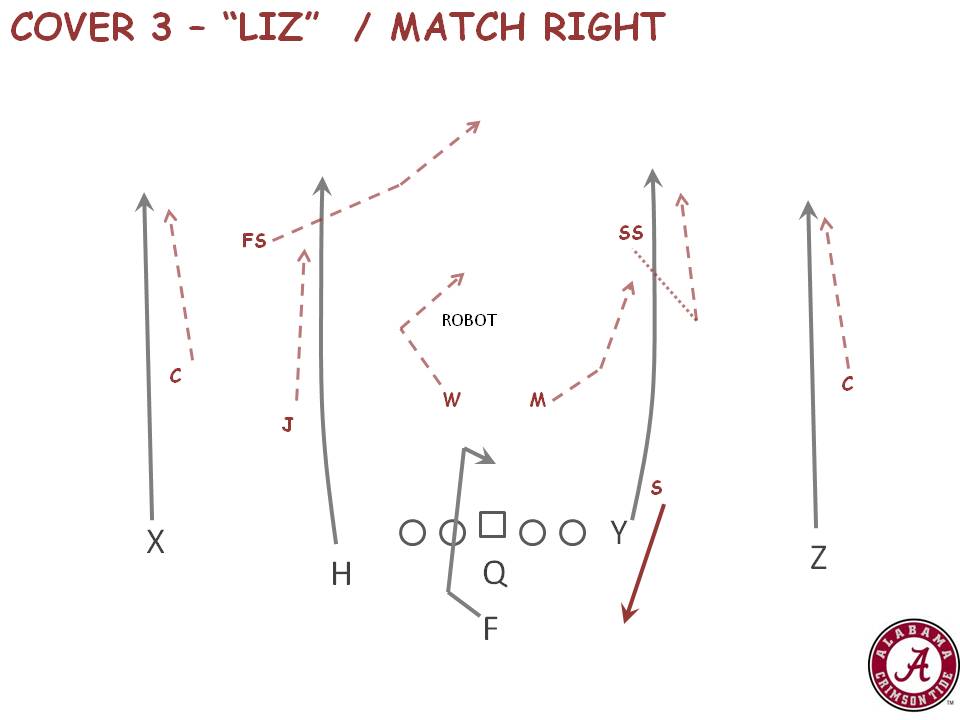
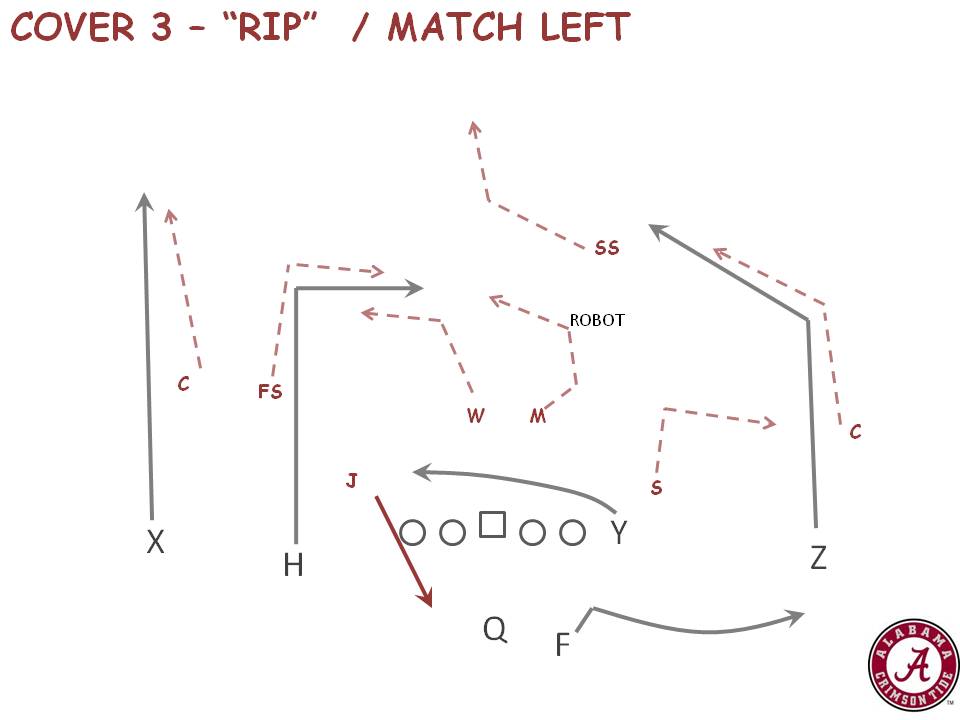
    The "Rip" / "Liz" call will alert the OLB to the call side that he has a safety coming down who will be assuming the Curl/Flat responsibilities. With the Rip/Liz declaration, the backers away from the call will alert to "Match" ("Rip - Match Left") their quick away from the call, and how the corner to his side will match their receivers. It is all premised on controlling #2 deep in the seam, by catching and carrying #2 vertical or outside past 12-15 yards (this should start sounding familiar to BRONCO/SCIF technique). If there is no threat of 2 verticals to a side, it really becomes your standard fare Cover 3. If #2 crosses / goes inside, he communicates with an "Under" call (alerting the backers inside to cut the receiver) and turns his focus to rob #1 underneath (like standard Curl/Flat Cover 3, robbing inside and underneath #1).
    It is essentially saying to the corners and C/F player, "versus two quicks, we're man-to-man all the way, unless our guys breaks inside". The communication is the vital part of the equation. Because the defense is presenting a 2-high shell, you could be playing a Cover 2, 4, 7, or 8 concept, but when you drop the safety down, you have to have a fast and efficient way to communicate which safety is dropping and how the backers away from the drop will respectively handle their threats.

    Worst case scenario in Cover 3 is the 4-verticals concept (4 receiver on 3 deep defenders). Rip/Liz match specifically handles this. If you accommodate for 4 verts, you aren't left with many other issues that can hurt you because you will still have 6 in the box. Getting down to brass tacks, lets review how this concept fleshes itself out.

    If #1 is vertical and #2 is vertical (VERTICALS)


    #1 presses vertical, the corner takes all of #1 - #2 presses vertical, the C/F players takes all of #2
    The inside linebackers will match #3 as he presents himself, looking to expand from the hook zone. By carrying the two inside verticals, remember you still have a middle of the field safety, so the backer/safety carrying #2 can maintain a low-shoulder, outside leverage on the receiver. This puts him in great position to discourage the SAIL (or 'pole') deep out break of #2 if it were to develop (past 12-15 yards).

    If #1 is vertical and #2 is outside (SMASH)

    Looking at the quick game smash concept (backside 5-step check), you can see how this is handled. #1 into the smash (right side of the diagram) takes all of #1 because he hasn't stemmed inside ("under" call, remember) and the C/F match player here handles all of #2 (vertical-outside). On the backside (here the 'rip' adjustment ~ left of the diagram), #1 stems vertical, so the corner matches all of #1. The #2 receiver runs a speed out, so the safety takes him man-to-man.

    If #1 is inside and #2 is vertical (DRIVE)

    Now a little tricky, the backside match (left diagram, away from 'liz'), has #1 immediately inside on a shallow, so the corner can sink and be over the top of #2, who is running a vertical (past 12 yards) stem into a dig. Because #2 is not inside ("Under"), the C/F safety matches #2 outside and underneath. With the shallow by #1, the backside inside linebacker is looking to cut the crosser (X) and the nearside inside linebacker will ROBOT the dig (depth and rob underneath).

    If #1 is vertical and #2 is inside (SHALLOW)

    Here, you see (right side of diagram) the match principle of the backer does NOT have a vertical stem of #2, so he declares the "Under" call, alerting the backers to ROBOT and CUT, as he will play standard Cover 3 curl-to-flat rules (with not threat to the seam), gaining depth and width (underneath #1 to his side).

    If #1 is inside and #2 is inside (QUICKS / YOGI strong flood)

    With the vertical stem of #2 (right side of diagram) the C/F match player carries him and since he is playing outside-underneath leverage, can easily take all of #2 with the outside break. With #1 vertical, the corner can match all of #1, as he would on a vertical #1 in Cover 3. The nuance here is that #3 is immediately releasing to the flat. The inside linebacker to flow (M) can be the final 3 player as there was no "Under" call. This eliminates the easy flood against Cover 3 (and remains consistent with Cover 4 rules and SCIF/Bronco rules).

    "Rip/Liz" is an adaptation of 3 Deep zone. How the corners and backer/safety support is primarily a game plan adjustment and can be tweaked on how your opponent actually uses 2x2 route packages. Now, you may be saying, "thats all well and good, but what about trips and empty"? Right, that will be up next, when we explore Saban's "mable" adjustment to Trips/Trey formations.

    UPDATE: Be sure to check out the 'breakout' session in the comments section below. Also, the adjustment to 3x1 "Mable" is located here. In addition, here is the only film representation of Rip/Liz I could find (outside of a broadcast) of the safety spin, Cover 3, versus 2x2. It doesn't represent the pattern match well because it was a bubble screen, but you can pick up on the fits, backer response, and leverage of the C/F players


    FYI - I will update THIS POST with coverage cutups soon, illustrating this being used in game situations. Much respect to my guy, Chris Vasseur, for helping me flesh out the details here and who is also running this with the program he's at now. Also, to coach Chip Bilderback, who's contributions to providing Saban's adapations have proven invaluable.


    This blog is primarily just a way of sharing and exchanging coaching information; just trying to pass along nuggets that may help you and your team. Handling spread is an interesting task, and this was one way of adapting a 1-high defense to meet the needs of a threat. Next, we'll take a look at a defensive coordinator's other option for handling the spread, by going into detail of Gary Patterson's TCU "2 Read" handling 4-verticals.

    Nebraska Pressure: Spinner (6 & 7 Man Blitz)

    In the first installment, we covered Nebraska’s base front and the base principles about matching fronts with their Buck linebacker. But what happens when your base defense and personnel are not the best tool for the job? What happens when you get in long-yardage situations or the offense gets out of 21 / 11 personnel? How does Pelini handle these special situations?

    The spinner personnel grouping (3 DL, 1 Nickel + 1 Spinner) equates to a GATA package, and is premised on just that; getting after your ass. Whenever you see 3 DL in the game for Nebraska you can bet good money that they will likely end up in a 7 man pressure package supported by Cover 0. The most common concept Nebraska will use is known as “Steeler”.


    This simply puts the corners and safeties on split receivers and everyone else is collapsing the pocket. This is the simplest pressure package in football and most known as the “Tigercat” blitz from Jim Bates (of 90's era Dallas Cowboys renown). The numbers will always afford for 1 free rushing defender (no matter how many stay in to protect, the defense will always to bring 1 more than they can block).


    In spinner, the Ends will align head-up on the tackles to provide the threat of a 2-way go, though they will bull rush through the inside arm, to free up both the “C” gaps for Nickel/Safety edge pressure as well as help open the “B” gaps for Mike/Spinner blitzing. Versus 2 backs, the nose will always take the right “A” gap. Versus 1 back, the nose will bull rush the center. The edge rushers in this blitz have a "peel" assignment that allows them a free path to the passer unless the back releases to their side. In the event of a back release to their side, the rusher should peel off the rush angle and pickup the back in coverage from an inside-out leverage.

    All coverage defenders are playing in an off-man or ‘catch’ position on receivers, allowing the receivers to free release. This prevents the coverage defender from giving up a deep throw, as well as, allowing the defender to keep his eyes on the ball, looking to break on the interception the minute the receiver sticks into his break.

    If the slot matchup is better suited for a nickel / buck backer, the converse spinner adjustment is known as “thriller”. Exactly the same as "Steeler", with the exception of freeing up the safeties by engaging the Will / Buck ( substitute for Nickel) in coverage on inside receivers.


    As a change-up and counter to the Cover 0 pressures, a rotating man-free concept is available provide a little more insurance behind the blitz and provide middle of the field protection.


    The Back Dog pressure features an orchestrated overload to the Mike backer side of the ball. The Mike will be supported by a cross-facing nose (to open up the blitz lane), an end, and either the Buck Nickel or corner. The spinner will align away from the back, with the Mike to the back. The Weak Nickel will align to the tight end (or 4th receiver), with the Buc Nickel to the passing strength. This basic concept can be run based on personnel or field/boundary, the only adjustment (called from the safeties) would be from the blitzing corner or Buc Nickel.


    Examples of Spinner Back Dog 1 Comet being run:

    If you recall (or rewatch), during the Big XII Championship Game, after stalling Texas early in the 1st half, Pelini used his Spinner groupings to pressure McCoy all night into errant throws and interceptions.

    This is the primary look Pelini will give once this dime grouping is introduced. He does have other coverage variations (next post) that apply to the base defense, but rarely utilizes them if nothing more than a change-up.

    More 1-high (Kiffin)

    I was looking for some film to throw over to Trojanfootballanalysis, to anticipate what flavor the USC defense would have. Looking for the cliched "Cover 2" / "Tampa 2" to feed an echoing "sports fan" audience, I couldn't find any......just a ton of C1 and fire-zones (even when they SHOULD have been in 2-high, to which Ohio was able to exploit the seams by #2).

    enjoy


    09Tenn @ Yahoo! Video

    @1:32 of this clip is probably the best example of "the 'Rat in the Hole' cutting the Y shallow"

    Drew Brees: Serving up Cracklin

    The New Orleans Saints, since Sean Payton’s arrival in 2006, have been looking to aggressively attack defenses at will. Like a good batch of boudin, Payton uses as many ingredients as he can get his hands on. Last night, they were afforded the stage and competition to show off his patented recipe.

    Today, we’ll take a look at two plays, in particular, that illustrate the mastery of Brees attacking the oft-mentioned fire-zone blitz, as well as 1-high man-free coverage (both concepts detailed considerably before on here).

    The first example includes a 5-man pressure, bringing the nickel from the edge (on top of #2 into the field). Presnap, the Patriots show a 2-high coverage shell, with the press alignment on #2 and corners squatting in the flat. Brees points out the MLB (the +1 to the 3 down linemen and the linebacker crept up in the weak B gap), who would be assumed to be the potential blitzer (since both #2 weak and #3 strong have defenders on them in 'man' coverage). This would put the offensive linemen accounting for the nose, both ends, and the tight weak inside linebacker, leaving the right guard free to account for the MLB and/or assist with the nose. Only thing is, the MLB begins walking out to gain leverage on #3 (strong), who's aligned as a wing (in empty).

    This is an alert that not everything is as it seems.

    At the snap, the weak inside linebacker showing blitz bails to the middle hole and (should be) looking to #3 or any crossers to rob. The field side End and Nose pirate stunt inside to gain leverage for the blitzing nickel on the edge and the boundary outside linebacker is also blitzing.

    Where things go wrong (for the Patriots) is that the SCF player to the field is peeking inside (like he should be taking the hole). He fails to control the vertical stem of Henderson (#19) as he goes up the field. Making matters worse, the FS attempts to (over) compensate for the dropping strong safety (to the boundary) who's going to cover-down the #2 threat (who expands to the flat). With no immediate vertical threat by #2 weak, there is no weak receiver to respect, and with 3 receivers to the field side, the FS really should have been looking to match the immediate threats on Henderson's side.


    breesus @ Yahoo! Video
    The second example simply illustrates victimization of Cover 1 out of a 2-back set. Much like the Orange/Tan looks we detailed earlier, New England is going to present 2-high (MOFO) then screw the strong safety down late to get 8 in the box to stop what would be a predictable run down (2 tight ends, 2 running backs).


    With flow action, the linebackers keying #2 and #3 weak, the Saints are able to sucker them in to create the high-low conflict on the remaining free safety with a Post-Dig combo. The free safety bites on the Dig as it opens behind the linebackers, leaving the middle-of-the-field-breaking Robert Meachum, who already has out-leveraged his corner inside. Because the corner was expecting (rightfully so) inside help from the free safety, he assumed he could play Meachum in a low-shoulder trail position.


    free @ Yahoo! Video


    POO! AIIIEE!!!! Dats some goo' Cracklins, Cher!

    Of course, some folks jess don't have the stomach for Cajun cuisine.....


    PS

    Hats off to Randy Moss for perfecting the Johnny Walker Lindh beard-look. Not many can pull that off as well as he has.


    Top